
Bryan Elite Concrete builds concrete sidewalk and walkway work in Bryan, TX and has for more than 20 years, serving surrounding cities including Lake Bryan, College Station, Hearne, Caldwell and Gause. Walkways look like the simplest thing in this trade and are the most rule-bound, because the moment one is public it has dimensions somebody will measure.
Two different jobs share the same name. A garden path from a side gate to a back door is yours to design. A walk in the right of way, or one triggered by a site plan or a subdivision, has published requirements for width, slope, thickness and accessibility, and it gets inspected against them.
We build both, and we say which one you have before quoting. A private path priced as public work costs too much; a public walk built as a private path gets rejected once it is already down.
Public Sidewalks and What the City Requires
Width, Slope and Thickness
Public walks are built to the city’s own design standards rather than to preference, covering width, cross slope, running grade and thickness, and new sidewalks have to adjoin existing ones and taper to the required width. We work to the published detail and show you the dimensions in advance. Those numbers are also what an inspector checks against, so there is no advantage in improvising them.
Curb Ramps and Detectable Warning Surfaces
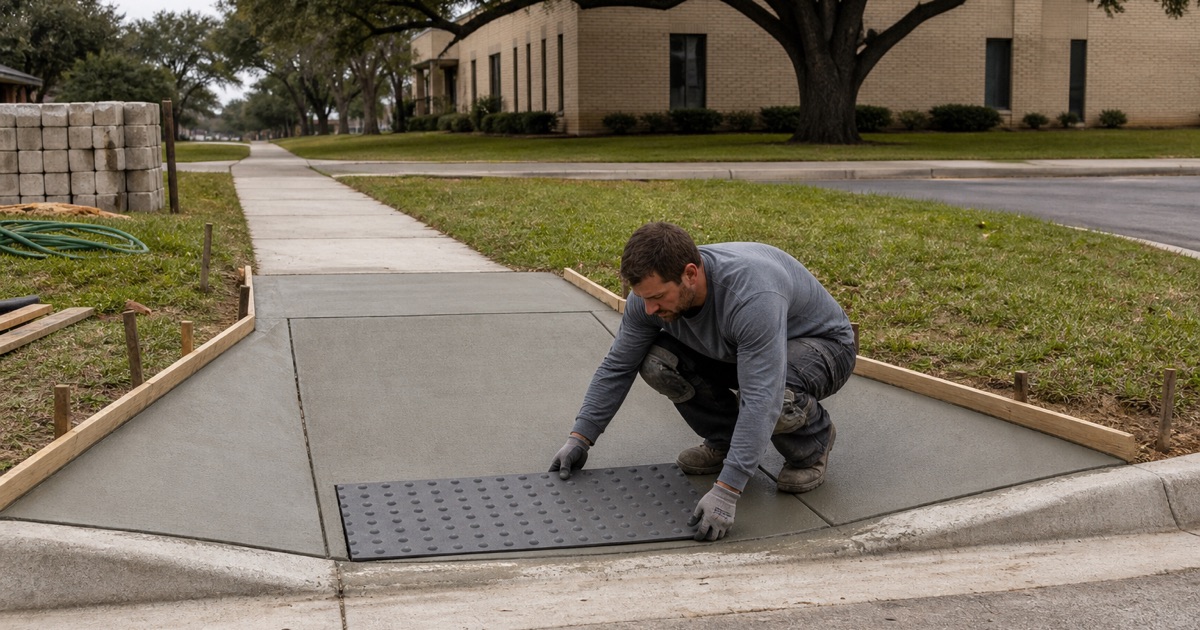
A ramp has to hold running slope, cross slope and a level landing simultaneously, which is why a ramp poured slightly out is a rebuild rather than a repair. Detectable warning surfaces, the truncated dome panels at the foot of a ramp, are specified by product and sometimes by color: within Travis Bryan Midtown Park the guidelines call for cast in place detectable warning surface in colonial red.
Walks Triggered by a Site Plan or Subdivision
Sidewalk obligations often arrive with a development rather than with a choice. A site plan under full review triggers sidewalks to city design standards on adjacent curb and gutter streets, with a payment in lieu available on the city engineer’s approval, and subdivision rules require walks on both sides of urban residential streets, arterials, collectors and cul-de-sac streets. We build to whichever applies.
Private Walkways Around a Home
Paths, Entries and Side Yards
On private property the design is genuinely yours, because Bryan’s Section 14-47 exempts private sidewalks and drives on private property from permits and inspections. We lay out paths around how the property is actually used, keeping a usable width where two people pass and where a wheelbarrow or a trash bin has to get through, rather than the narrowest strip that technically works.
Finishes That Grip When Wet
A walkway is the surface most likely to be crossed in the rain, so grip matters more here than anywhere else on a property. A broom finish is the sensible default, exposed aggregate gives more texture again, and where a decorative finish is wanted we add slip resistance to the sealer rather than leaving a glossy film on a path.
Steps, Landings and Grade Breaks
Where a walk changes level, consistent riser heights and proper landings are what stop it becoming a hazard, and an uneven riser at a door is the one people trip on repeatedly. We set grade breaks deliberately, keep risers uniform, and handle drainage at landings so water does not stand against a threshold every time it rains.
Repairing an Existing Sidewalk
Trip Hazards, Grinding and Panel Replacement
Where two panels have gone out of plane, concrete grinding removes the lip in a single visit with no forms, no cure time and no color mismatch, provided both panels are sound and supported. Where a panel is broken, rocking or has lost its base, grinding hides the symptom while the cause continues. We check support before choosing between the two.
Who Pays for the Public Walk in Bryan
The abutting property owner does. Section 106-92 makes repair of a defective public sidewalk or driveway the owner’s duty and expense, and says that duty exists independently of any notice from the city; Section 106-93 places primary liability for injury from a defective walk on that owner too. Failing to act within the stated deadlines lets the city do the work and file a privileged lien bearing ten percent interest.
The 50/50 Residential Cost-Share
Section 106-96 creates a 50/50 residential cost-share, and the owner has to initiate it. At least 15 linear feet per residence must need replacement, the sections have to meet defined defect thresholds rather than simply looking tired, surface spalling alone does not qualify, and the city replaces only to current design standards. We will tell you honestly whether your sections would meet those tests.
Walkways on Commercial and Multifamily Property
Continuity Through a Drive Approach
Where a public walk crosses a driveway approach, the walk has to continue through the crossing at the right thickness and reinforcement rather than simply stopping at each side. That junction is the most commonly botched detail on a commercial frontage and the one that fails first under truck wheels. We build the crossing as a single considered detail.
Accessible Routes and Landings
On commercial and multifamily property the walk is part of an accessible route, and the route is only as good as its worst cross slope, its narrowest pinch point and its steepest landing. We survey the whole run rather than quoting a panel count, because replacing one bad section within a route that still fails elsewhere solves nothing.
Maintenance, Joint Sealing and Liability
Sealed joints keep water out of the base under a walk, and a walk whose base stays intact does not develop the offsets that turn into claims. For property managers we survey the full site, list every defect with its location, and price the work as one program rather than reacting to complaints one at a time.
- 20+ Years Experience
- Free On-Site Quotes
- Written Scope and Specs