
Bryan Elite Concrete takes on decorative concrete in Bryan, TX and has worked with color, texture and finish systems for more than 20 years, serving surrounding cities including Lake Bryan, College Station, Hearne, Caldwell and Gause. Decorative work covers everything done to a slab’s appearance short of stamping it, which we cover separately: color systems, stains, exposed aggregate, sawcut work, polished surfaces and borders.
The useful way to think about it is that every decorative option is a different answer to the same question: where the appearance actually lives. Integral color runs through the full depth of the slab, a color hardener sits in the top layer, a stain sits at the surface, and a sawcut lives in the geometry rather than in any coating on it. Each of those repairs, wears and ages differently, and that difference is usually what should decide the choice.
The second question is local and it is heat. Anything walked on barefoot in a Brazos County summer has a comfort answer attached to its color long before it has a style answer, and that is a conversation worth having at the quote rather than in August.
Color Systems and How They Age
Integral Color Through the Full Depth
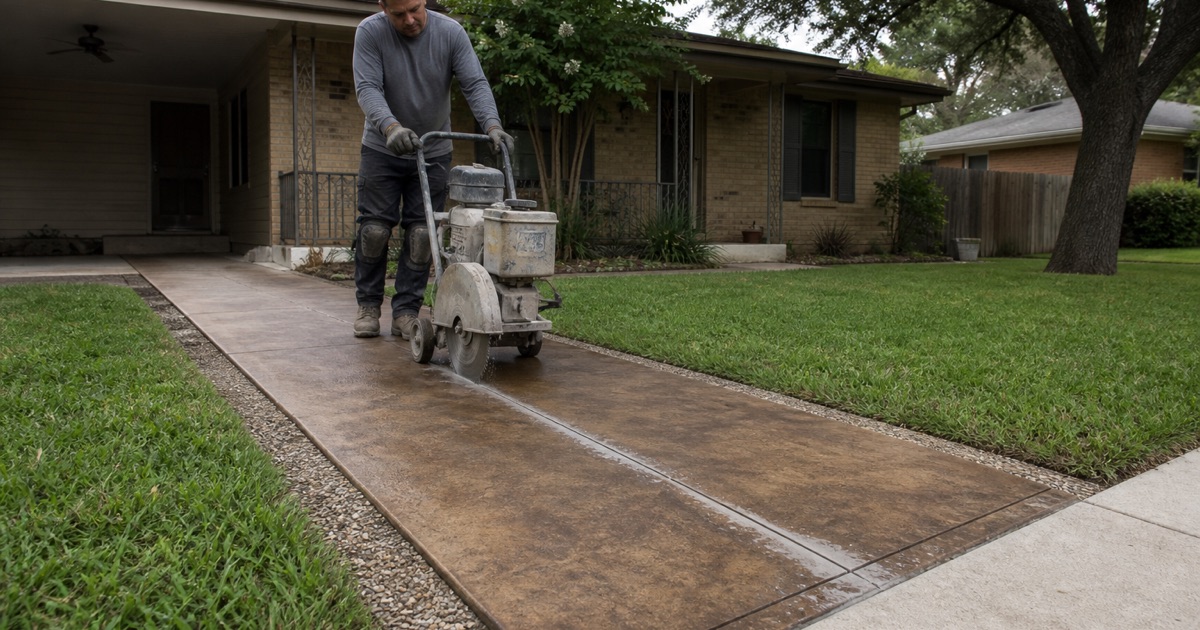
Integral color is dosed into the concrete at the batch, so the color runs through the whole slab. A chip, a saw cut or a drilled hole does not expose gray, which makes it the most forgiving system to live with and the easiest to repair convincingly. It gives softer, earthier tones rather than intense ones, and it holds those tones well under strong sun.
Color Hardener and Surface Density
A dry shake color hardener is broadcast onto the fresh surface and worked in, producing a denser, harder top layer and a more saturated color than integral alone. That density is a real durability benefit on a surface taking traffic. The trade-off is that the color is a layer, so deep damage exposes what is beneath and repairs need more care to blend.
Acid Stain, Water-Based Stain and Dye
Acid stain reacts chemically with the slab and produces a mottled, variegated result that cannot be exactly repeated, which is the appeal and also the risk. Water-based stains and dyes give more predictable, wider color ranges with less chemistry. All three sit at or near the surface, so they depend on a sealer for protection and on the substrate being clean and sound.
Texture, Aggregate and Cut Work
Exposed Aggregate and Seeded Finishes
Exposed aggregate removes the surface paste to reveal the stone in the mix, giving grip, texture and a surface that disguises staining and wears slowly. A seeded finish presses selected stone into the surface for a specific look rather than relying on the mix. Both suit driveways and paths well, though Bryan will not replace an exposed aggregate public sidewalk under its cost-share program.
Sawcut Patterns, Borders and Banding
Sawcut lines turn a plain slab into a designed one for very little money, and they can be laid out to double as control joints so the pattern and the crack control are the same lines. Contrasting borders and banding frame a field and give a clean edge where a texture cannot run cleanly to a form. We draw the layout before the pour rather than deciding it with a saw.
Broom, Salt, Float and Polished Finishes
The finish itself is a decorative decision. A broom finish grips and suits anything outdoors; a salt finish gives a fine pitted texture; a float finish sits between broom and trowel; a polished or burnished surface belongs indoors and under cover. We match finish to exposure and traffic first, and to appearance second, because a beautiful finish in the wrong place fails at both.
Where Decorative Concrete Suits the Property
Entries, Courtyards and Front Walks
The front of a property is where decorative work earns most, because it is seen at close range, walked at low speed and carries no vehicles. Colored and cut concrete here can pick up the brick, stone or trim already on the house. In a historic preservation overlay district, pavement materials need a certificate of appropriateness, so we check the district before designing.
Patios, Outdoor Living and Pool Surrounds
Around outdoor living areas the priorities shift toward heat and grip, which narrows the palette usefully. Lighter integral colors with a real texture perform far better underfoot in summer than dark, smooth finishes, and they show less of the dust and pollen that settles on everything here. We specify these around bare feet rather than around a photograph.
Commercial Entries, Plazas and Branding
On commercial property, decorative concrete does wayfinding as much as decoration: a banded border defining an entry, a change of texture marking a crossing, a color break separating pedestrian space from a drive aisle. It also has to survive maintenance equipment and heavy foot traffic, so we specify for cleaning regimes and traffic first and appearance within that.
Living With a Decorative Surface
Sealers and the Maintenance Interval
Almost every decorative system depends on a sealer to keep the appearance it was sold with, and a sealer is a maintenance item rather than a permanent coating. We name the product used, the interval it needs renewing at, and what the surface starts to look like as that point approaches. Decorative concrete left unsealed is where the reputation for fading comes from.
Repairs, Additions and Matching
Repairing decorative concrete is harder than repairing plain, and each system behaves differently: integral color repairs best, hardener needs blending, stain is the most difficult to match. We tell you this before the system is chosen, not after damage happens, and we keep a record of what was used so a future repair starts from information rather than from guesswork.
Cleaning Without Damaging the Finish
Most decorative surfaces are damaged by maintenance rather than by use: pressure washing at close range that cuts the sealer, harsh cleaners that etch stain, or de-icing chemicals on a sealed surface. We hand over simple written guidance on cleaning, because the surface will outlast several rounds of whoever is looking after the property.
- 20+ Years Experience
- Free On-Site Quotes
- Written Scope and Specs