
Bryan Elite Concrete builds concrete pool deck work in Bryan, TX and has for more than 20 years, serving surrounding cities including Lake Bryan, College Station, Hearne, Caldwell and Gause. A pool deck is the one slab on a property that is routinely walked on wet, barefoot and in full sun, and every specification decision follows from those three facts.
Most of what goes wrong on a pool surround is decided at selection rather than at placement. A color chosen indoors turns into a surface nobody can cross at four in the afternoon. A finish chosen for how it photographs turns slick the moment it is wet. Neither is repairable without replacing the surface.
The other half is drainage, and it runs the opposite way to instinct. A deck has to shed water away from the pool rather than into it, so that dirt, chemicals and runoff do not end up in the water, and it has to do that without ponding at the coping. That gets set at layout, before anyone talks about pattern.
Surfaces Built for Wet, Bare Feet
Slip Resistance That Works When Wet
Texture has to function under water and bare skin, not just look textured. A broom finish, a salt finish or a deep stamp all give real relief; a hard steel trowel does not. Bryan’s own Travis Bryan Midtown Park guidelines take the same view for public work, calling for a broom finish on walking surfaces expected to be routinely wet, and we apply the same logic on a private deck.
Heat, and Why Color Is a Comfort Decision
Surface color drives surface temperature more than anything else on a decorative pour, and a pool deck is where that becomes unavoidable. Creams, buffs and light grays stay noticeably cooler underfoot than charcoals, deep browns and heavy reds under the same sun. We raise the trade-off during selection and show samples cured outdoors rather than under showroom light.
Sealers, Additives and What They Change
A sealer deepens color and resists staining from sunscreen, leaves and pool chemicals, and it can also undo the texture beneath it if the wrong product goes down glossy. Where the surface is walked on wet we specify a non-slip additive in the sealer as standard. Sealer is a maintenance item with an interval, and we tell you what that interval is.
Getting the Layout and Drainage Right
Fall Away From the Pool
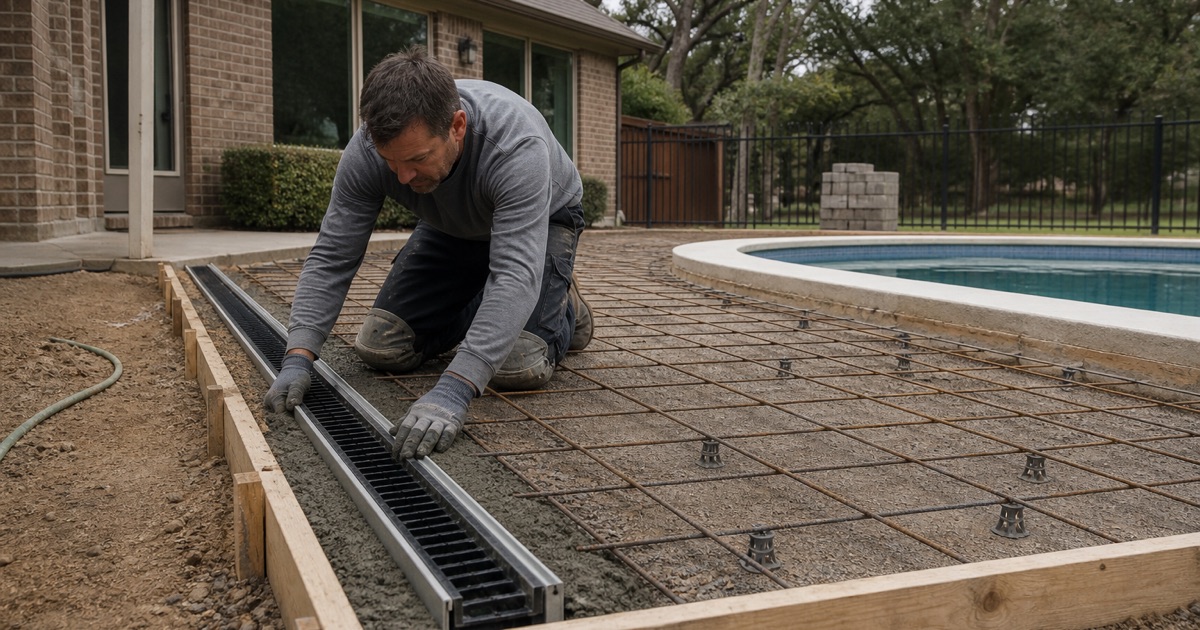
Decks are graded so water leaves the surface away from the water line, taking dirt and chemicals with it, and so that no low spot holds a puddle beside the coping. Where the yard slopes toward the pool, the answer is a designed edge, a drain line or a discreet swale rather than more concrete. We set this at layout because correcting it later means cutting finished work.
Coping, Expansion Joints and the Pool Shell
The deck and the pool shell are separate structures that move independently, so the joint between them is expansion joint material and sealant rather than a rigid connection. Getting that detail wrong is what cracks a deck along the coping line. We detail the perimeter deliberately, including where the deck meets tile, coping and any raised bond beam.
Equipment Pads, Conduit and Access
Pump, filter and heater equipment needs a level pad that will not settle, drainage away from the equipment bay, and conduit and plumbing runs sleeved before the pour rather than cut in afterward. We coordinate those routes with your pool contractor at layout. Cutting a finished deck for a forgotten line is the most avoidable damage on this kind of project.
New Decks, Extensions and Resurfacing
New Pool Decks
On a new deck we build the slab properly first: subgrade proof rolled and corrected, base compacted in lifts, reinforcement on chairs, thickness set for the traffic and any furniture or cover that will sit on it. Decorative treatment is applied to a slab that would have been sound plain. That order is what keeps a decorative surface from failing structurally.
Extending or Reshaping an Existing Deck
Extending a deck for a seating area, an outdoor kitchen or a sun shelf is common work, and the honest caveat is color. New concrete stays lighter than weathered concrete for a season or more. We match finish and joint layout as far as materials allow, decide deliberately whether to dowel or isolate the connection, and tell you where the join will read.
Resurfacing a Sound Deck
Where the slab is structurally fine and the surface has simply aged, a textured overlay or spray-down system restores appearance and improves wet grip without disturbing coping or tile. That depends on a substrate that will hold a bond, so we test before quoting. Where the deck has settled instead, leveling comes first and any surface work afterward.
Commercial and Multifamily Pool Decks
Apartment and Student Housing Pools
In a market with this much rental and student housing, a pool deck is a leasing asset with a maintenance liability attached, and the same surface serves hundreds of people rather than one family. We specify for heavier traffic, plan the work into the turn between leases where possible, and keep the schedule dates we commit to.
Accessible Routes and Level Changes
Around a commercial pool the deck is part of an accessible route, so cross slope, level landings and transitions have to hold across the whole run rather than in the sections that were easy. We survey the full route before quoting, because replacing one failing area within a route that still fails elsewhere solves nothing on an inspection.
Repairs, Joint Sealing and Trip Hazards
The common failures on an older commercial deck are offsets at joints, open joints letting water into the base, and settlement at the equipment side. Grinding, resealing and targeted panel replacement handle most of it without closing the pool for a season. We survey the whole deck, list every defect and price it as one program.
- 20+ Years Experience
- Free On-Site Quotes
- Written Scope and Specs