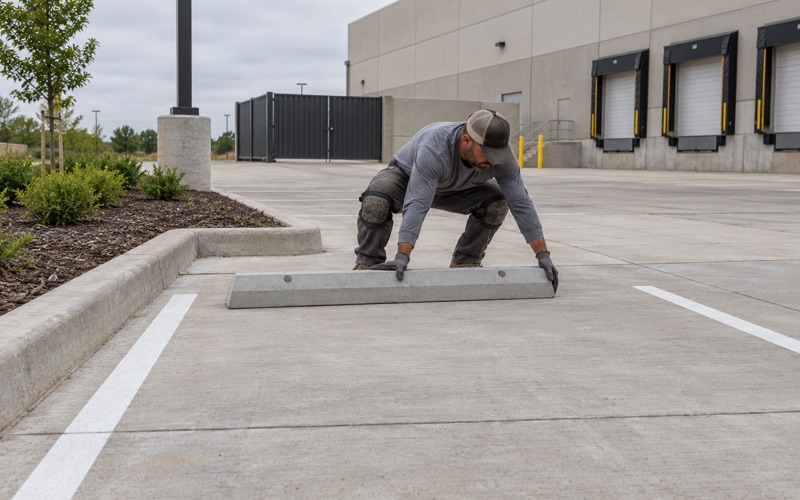
Bryan Elite Concrete works as a concrete contractor in Rockdale, pouring parking pads, driveways, slabs and repair work with more than 20 years behind the crew. Something changed here in November 2024 that most property owners have not caught up with, and it decides whether the place you park is legal.
Ordinance 2024-11-20(7A) made parking in a front or side yard on an unimproved surface an offense. That single change turned an informal gravel patch or a worn strip of grass from a habit into a code matter, and it is now the most common reason we get called out to price a parking pad here.
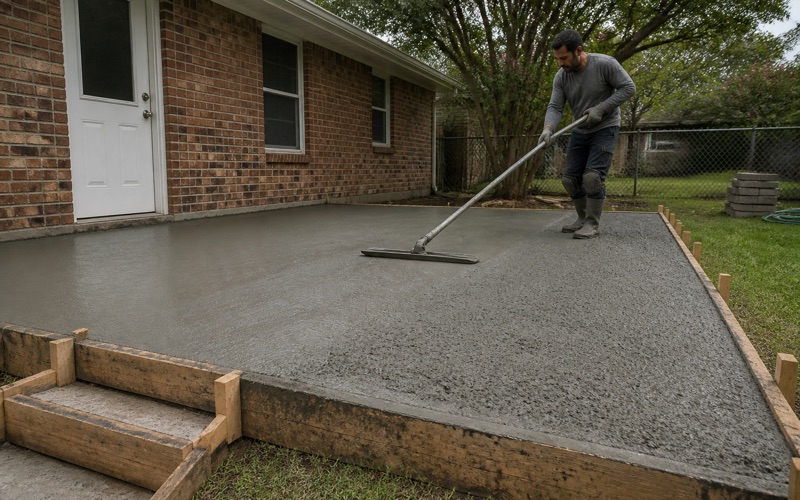
The interesting part is what satisfies it. Gravel meets one section of the code and fails another, which leaves a gravel pad laid after that ordinance in an awkward middle position. Concrete satisfies both, which is why the answer to this ordinance is usually a slab.
What the 2024 Parking Ordinance Changed
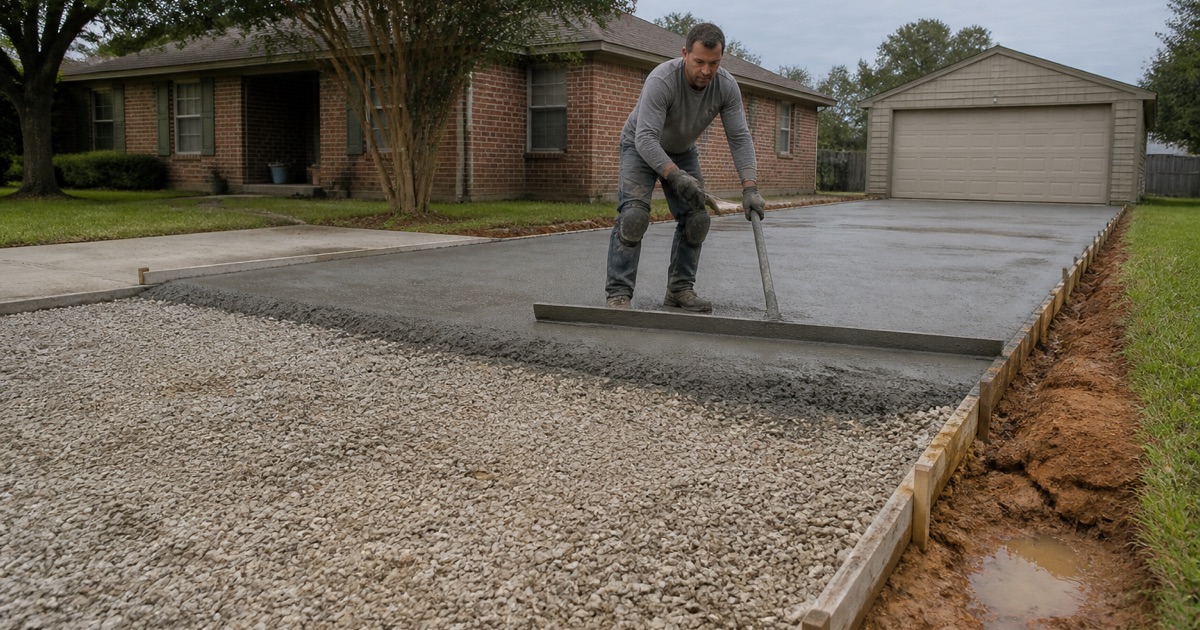
An Offense, Not a Preference
Front and side yard parking on an unimproved surface is now an offense rather than an untidy habit, which changes the conversation from aesthetics to compliance. For a rental owner or a property manager it is a notice risk on every unit where a tenant parks off the drive.
We look at the whole frontage rather than the one spot when quoting these, because a pad that solves the cited location while leaving the same problem ten feet away has not really solved anything. The point is to end the exposure, not to move it.
The Gap Between Two Sections
Here is where the code is genuinely awkward. Gravel satisfies section 12.04.018(c)(2), so a gravel pad does answer that provision. But section 14.02.004 states that gravel is not an all weather surface, so the same pad fails the other test.
The practical result is that a gravel pad laid after the 2024 ordinance sits as legal nonconforming rather than conforming, while concrete satisfies both provisions cleanly. If you want the question closed rather than parked, the material choice is already made for you.
What a Conforming Pad Actually Takes
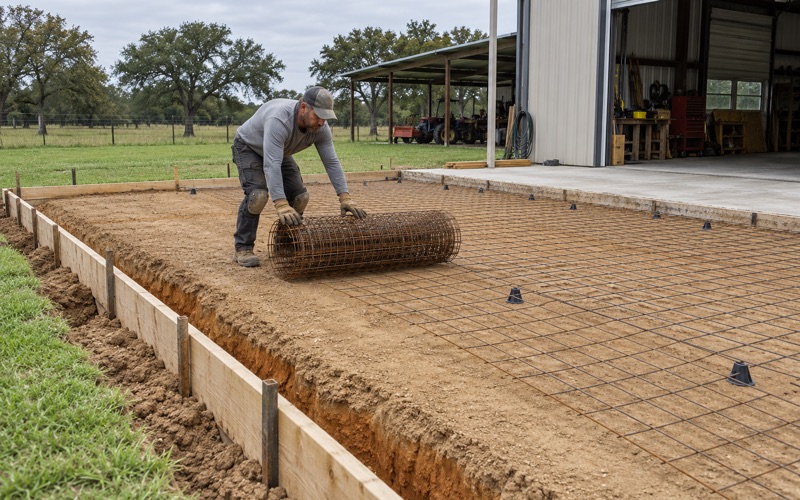
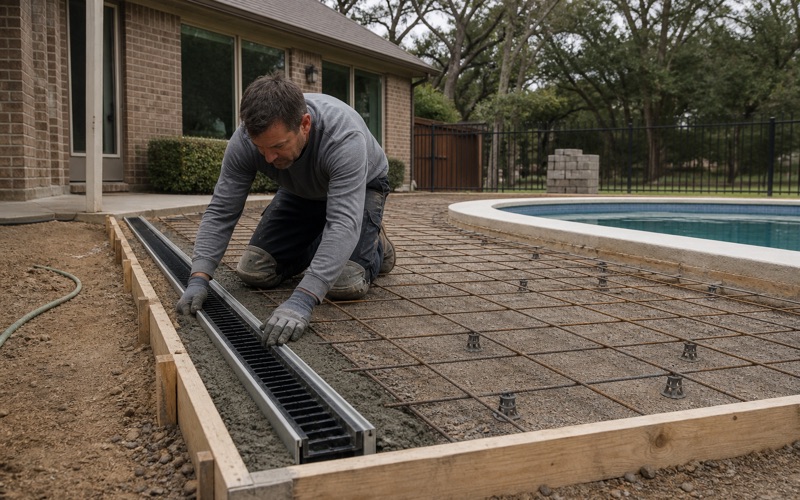
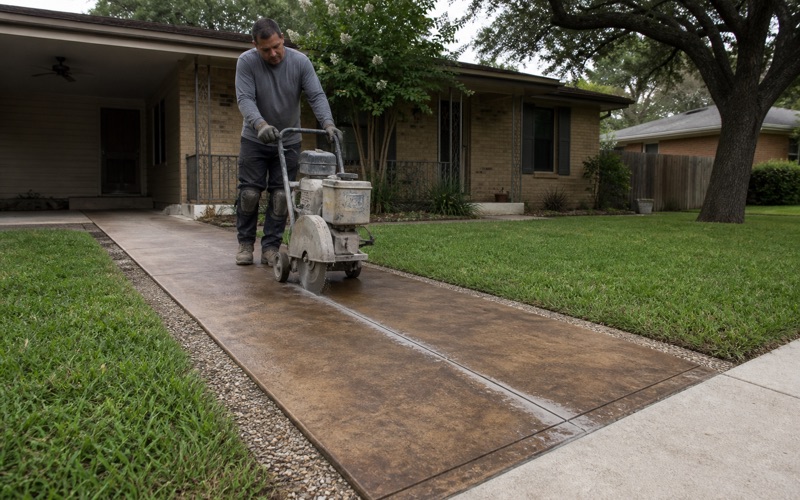
A conforming pad is a designed slab rather than a poured rectangle. It needs a base built for the vehicles using it, a thickness matched to those vehicles, jointing that decides where cracks go, and drainage that gets water off the pad and away from the house rather than into the yard beside it.
There is also a cap to respect. Residential impervious cover is limited to 50 percent, so adding a parking pad to a lot that already carries a drive, a patio and a walk is an arithmetic question before it is a construction one. We measure the existing cover before proposing an area.
Looking for concrete contractor closer to Cameron? See Concrete Contractor in Cameron.
What Is Under a Rockdale Slab
Sandy on Top, and Not Forgiving
Area weighted across the city, the surface here reads 76.4 percent sand at a plasticity index of 6.3, over a subsoil at 30.0 percent clay and a plasticity index of 20.4. A sandy yard reads as easy ground and behaves as anything but, because the sand is a conduit rather than a foundation.
Rader loamy fine sand is the most extensive unit at 33.0 percent of the city, and its profile is the local problem in one column: 83.5 percent sand at a plasticity index of 3 through the top layers, then 42.5 percent clay at a plasticity index of 28 lower down. Saturated conductivity falls from 92 micrometers per second at the surface to 0.21 in the clay, a drop of more than 400 times in one profile.
Perched Water From December Through May
Rader carries an apparent wet zone at roughly 36 to 45 inches deep in December, January, February, March, April and May. That is water moving fast through the sand and stopping on the clay rather than a high regional water table, and it is seasonal rather than constant.
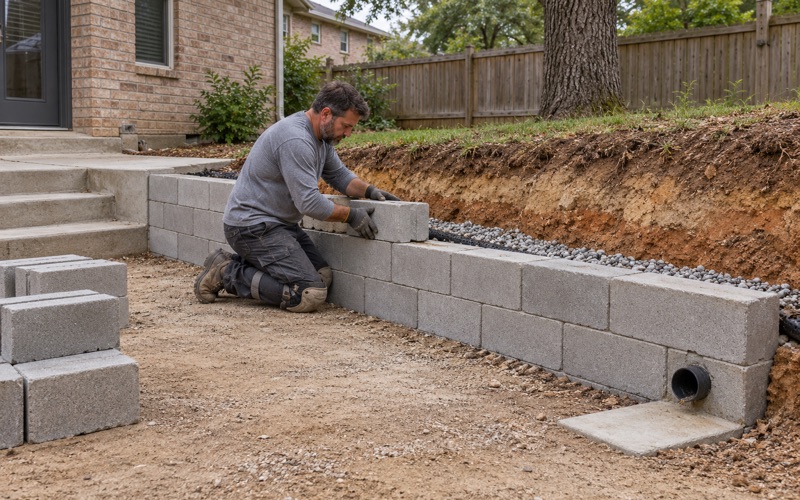
It matters for scheduling as much as for design. Winter and spring excavation on those units meets wet ground at a predictable depth, so we plan base correction and dewatering for the season rather than being surprised by it, and we build drainage that keeps the perched zone from finding the underside of a slab.
Where Stabilization Fires
The city’s street specification uses a threshold the local soil data straddles. Section 10.02.103(b)(7) requires subgrade stabilization under all street pavement where the subgrade plasticity index reaches 15, at 6 inches thick with 6 percent hydrated lime by weight, compacted to 95 percent standard Proctor density.
About 12.2 percent of the city sits at or above that threshold, so the requirement fires on some ground here and not on most of it. Knowing which before quoting is the difference between an accurate price and a change order, which is why we test rather than assume from the neighborhood.
Specifications, Driveways and Culverts
The City’s Own Numbers
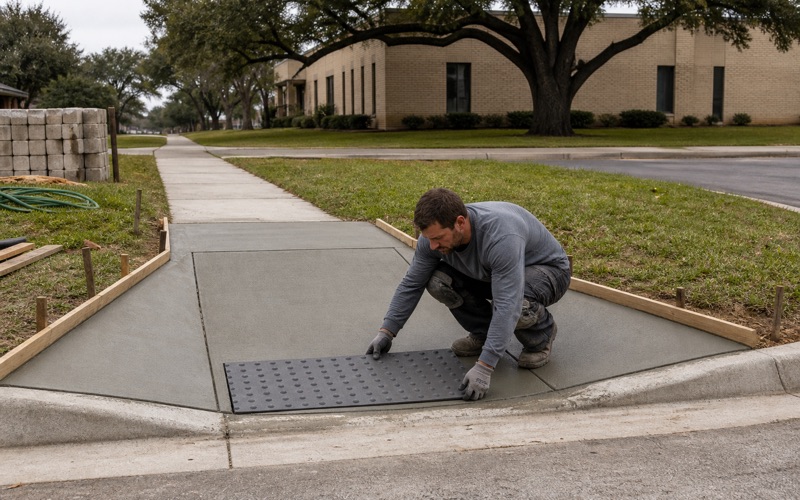
Street pavement here is specified at 3,500 psi and public sidewalk at 3,000 psi, not less than 4 inches thick, placed on a 2 inch sand cushion and reinforced with 6 by 6 number 10 gauge welded wire fabric. Minimum walk width is 6 feet on local and collector streets and 8 feet on arterial streets, with a transverse slope of a quarter inch per foot from the back of curb.
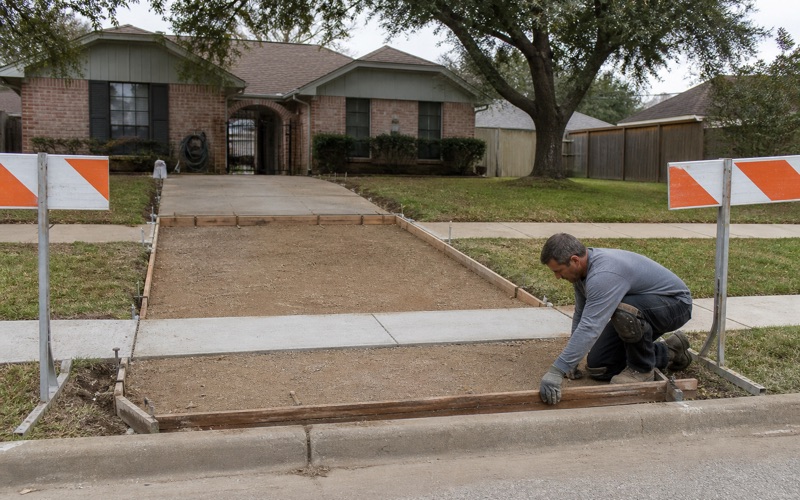
Driveway returns are dimensioned as well, at 10 feet on residential streets and a minimum of 10 and a maximum of 20 feet for commercial and industrial driveways except in special cases. We build to those figures and show them to you, because they are what the work is checked against.
The Driveway and Culvert Permit
Section 3.04.005(b) requires a permit application to the Code Enforcement Official before installing or altering a driveway or culvert, and work may not commence before a permit issues or the official confirms in writing that none is required. The exemption test here is local rather than the model code’s: no permit for minor repairs and alterations that do not affect the size or location of impervious cover.
The driveway permit runs $100.00 with flatwork charged at one cent per square foot, and working without a permit costs double the permit fee. Completed driveway work is inspected, a project found out of compliance has 30 days to comply before the permit voids, and an existing driveway the council considers a public safety threat must be corrected at the owner’s expense within 60 days of notice.
Ditches, Culverts and Who Keeps Them Clear
Where a street has no curb and gutter connected to a storm sewer or drainage ditch, draining ditches are installed along the roadway at the adjoining owner’s expense, and no driveway may be built or maintained over a ditch without a culvert to specifications the city approves.
The maintenance obligation stays with the property afterward: the owner and the occupant of the abutting property must keep the culvert and the ditch free of obstruction. Outside the city, Milam County’s own permit governs, priced by use at 25, 150 and 5,000 dollars and with the county installing culverts at 15 dollars per foot on a 30 foot minimum.
Getting It Permitted, and What Happens If You Do Not
The Bond Before the Permit
A bond or cash deposit is required before any permit issues, scaled to construction cost. Nothing is required up to $500.00; above that the ladder runs from a $250.00 surety bond or $25.00 cash, through a $1,000.00 bond or a $100.00 deposit for the two-to-five-thousand band, up to thirty-three percent of costs as bond or ten percent as deposit above $30,000.01.
Insurance sits alongside it. Before starting a project needing a bond or deposit, the applicant must show public liability and property damage cover of $100,000.00 for bodily injury or death of one person, $300,000.00 for two or more persons in any accident, and $100,000.00 for property damage in one accident, with a waiver available for minor projects.
A Pre-Pour Inspection and a Thirty-Day Clock
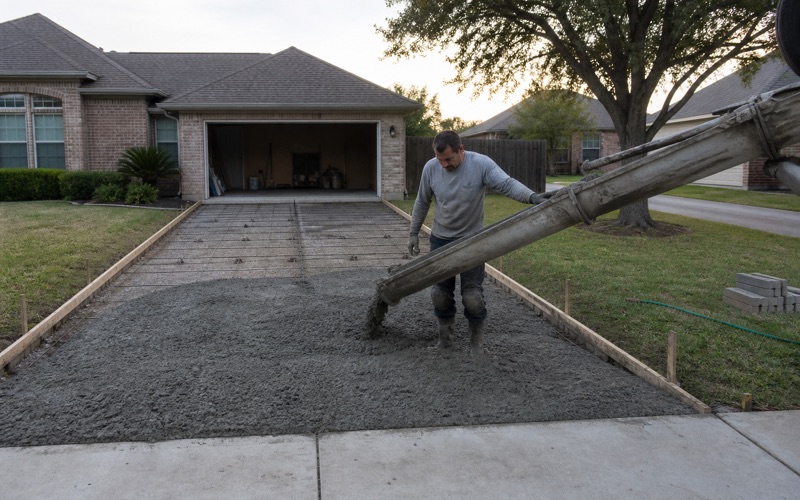
The required inspection sequence includes a pre-pour stop: the foundation inspection is made after trenches are excavated and forms are erected under section 3.02.004(g)(1), and work requiring a permit may not commence until the permit card is posted conspicuously and protected from the weather.
The thirty-day cure period on non-compliant driveway work is the one worth watching, because after it the permit is void rather than merely overdue. We schedule inspections into the sequence rather than around it, so a concrete order is never waiting on a hold that could have been cleared a week earlier.
Your Tear-Out Needs a Container
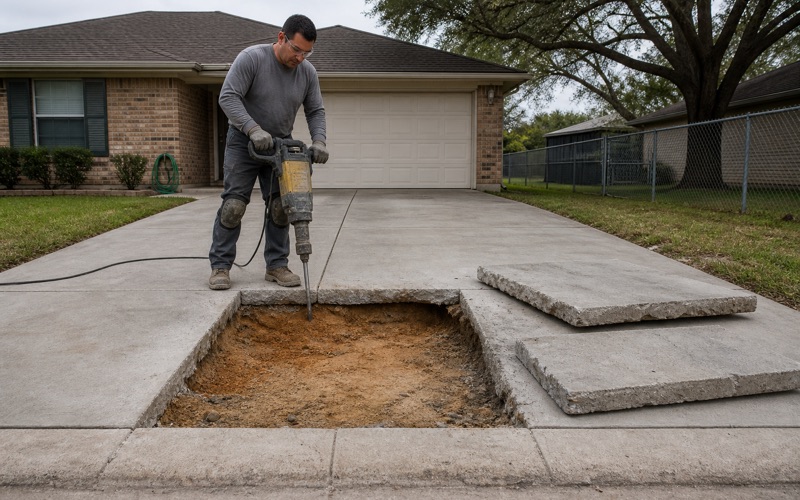
Debris here is regulated by method rather than by the load. Section 3.02.017 requires each contractor and property owner performing work within the city to lease, at their own expense, a roll-off container of sufficient size from the franchise collection agency and keep it at the construction site, with each building permit representing a construction site.
Litter, debris, dirt and mud deposited on any public place or private premises must be removed daily. We price the container and the daily cleanup into the job rather than leaving them out, and on street work we note that cuts are billed by area at $6.00 per square foot with a right-of-way permit application at $100.00, valid for 120 days.
- 20+ Years Experience
- Free On-Site Quotes
- Written Scope and Specs