Bryan Elite Concrete works as a concrete contractor in Navasota, pouring driveways, slabs, pads and repair work with more than 20 years behind the crew. On roughly one lot in five inside this city, the first question about a concrete job is not what it costs or how thick it is. It is whether the pour is a floodplain matter.
That is not a figure of speech. The city defines development for floodplain purposes as any manmade change to real estate including filling, grading, paving and excavation, so a driveway, patio or parking pour inside the special flood hazard area is development and needs a development permit rather than a simple flatwork approval.
We check the mapped zone for an address before quoting, because the difference between an ordinary driveway and one requiring a sealed engineering report is thousands of dollars and several weeks. Finding it at the quote is a conversation. Finding it later is a stalled job.
One Lot in Five Is in the Flood Zone
How Much of the City, and Which Zones
Sampling the national flood hazard layer against the city’s own boundary puts about 20.8 percent of the incorporated area inside the special flood hazard area, split roughly 8.7 percent Zone A, 8.7 percent Zone AE and 3.4 percent designated regulatory floodway. The effective countywide flood insurance rate map dates from April 3, 2012.
Those three zones are three different jobs. Zone AE carries a published base flood elevation to build against, Zone A does not and the number has to be established another way, and the floodway is the most restricted of all. Roughly one lot in thirty here sits inside the floodway itself.
Why the Soil Survey and the Flood Map Disagree
Frequently flooded soils cover only about 4.2 percent of the mapped soil area inside the city, mostly Gowker along the creek bottoms, which is far less than the 21 percent the flood map designates. Both figures are correct because they measure different things.
The soil class describes how often the ground itself floods; the FEMA zone is a one percent annual chance hydraulic result that includes large Zone A areas mapped by approximate methods. The practical consequence is that plenty of ordinary upland-looking lots here carry a Zone A designation without carrying bottomland soil at all.
Checking Your Address Before Anything Else
Because the mapped zone does not follow what the ground looks like, guessing from appearance is unreliable. We look the address up against the effective map at quote time and tell you which zone it falls in and what that implies for permits, elevation and engineering.
That check costs nothing and changes everything downstream. It decides whether we are quoting a straightforward pour, a pour with a development permit attached, or a job that needs an engineer engaged before a price can be honest.
Looking for concrete contractor closer to Madisonville? See Concrete Contractor in Madisonville.
What Being Called Development Changes
The Sealed Drainage Report
A development permit application in the special flood hazard area asks for a drainage report prepared and sealed by a Texas registered professional engineer, with runoff calculated for the 5, 10, 25, 50 and 100-year storms and detention provided for the difference between pre-development and post-development runoff at the 100-year storm.
The exception is where the engineer can show the site drains ahead of the hydrograph peak. On any large impervious pour near the creeks that report is a real line item, and it belongs in the budget and the calendar from the beginning rather than appearing as a surprise once the application is filed.
One Foot of Freeboard Inside the City
Navasota’s freeboard is one foot. New construction and substantial improvement of a residential structure must have the lowest floor elevated one foot above the base flood elevation, certified by a registered engineer, architect or land surveyor, and nonresidential construction must either match that or be dry floodproofed with a professional certification.
That elevation requirement drives fill volume, forming height and how the surrounding grade has to be shaped, all of which are concrete costs rather than paperwork costs. Where a slab has to come up, we work out the fill and the retention of that fill as part of the design rather than as an adjustment on site.
Fill in the Floodway Is Barred Without a No-Rise
Inside the designated floodway, encroachments including fill are prohibited outright unless a registered professional engineer or architect certifies that there will be no increase in flood levels at the base flood discharge. A slab on grade normally means bringing in fill, so that certification is the gate rather than a formality afterward.
We treat a floodway address as an engineering conversation from the first visit. There is no version of that job where a contractor can quietly place fill and sort the paperwork later, and pretending otherwise is how an owner ends up with an unpermitted structure in the most sensitive part of the map.
Permits, Specifications and Street Work Inside the City
The Driveway Permit and Naming Your Contractor
The city’s fee schedule carries a named driveway permit at $70.00, alongside a carport, a covered patio and a fence at the same figure, with reinspection also at $70.00. Anyone wanting a driveway approach applies in writing to the development officer, who then prescribes the construction procedure.
The application must name the contractor who will do the work and attach a sketch showing the driveway and the parking area or doorway it connects. Since Texas issues no state license for concrete contractors, being named on that application is one of the few points where a homeowner’s choice of contractor is on the record with the city.
Mix and Slump Are Specified, Not Assumed
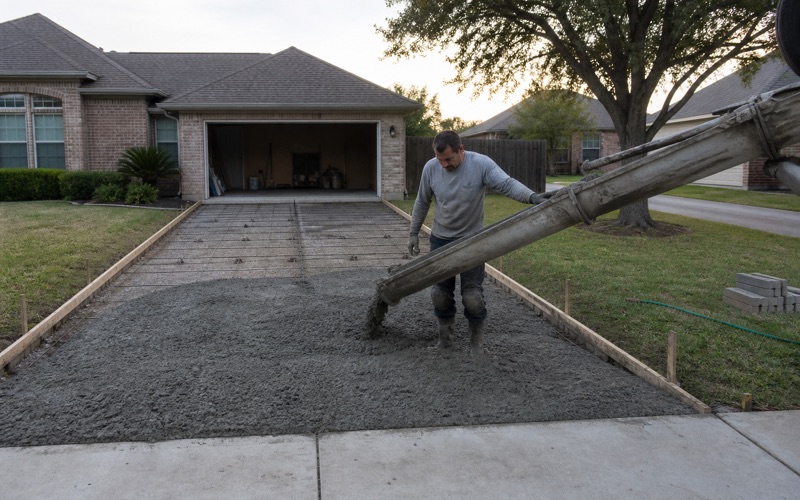
The city’s own specification distinguishes pavement from walk: 3,500 psi at a 3-inch slump for pavement and 3,000 psi at a 5-inch slump for sidewalk. Those are written numbers rather than trade preferences, and they are the ones a job here is measured against.
We order to the specification, keep the batch tickets for what actually arrived, and hand them over. On any pour tied to a permit, that documentation is the difference between an inspection that closes and one that turns into a discussion about what was in the truck.
Street Cuts, Bonds and Tear-Out
Cutting, removing or repairing any part of a street surface here needs a separate permit, and before it issues the applicant must post a performance bond in an amount set by the city manager, signed by at least one corporate surety licensed in Texas. Street cut repair is priced at $200.00 per square yard for a concrete street and $100.00 for an asphalt street.
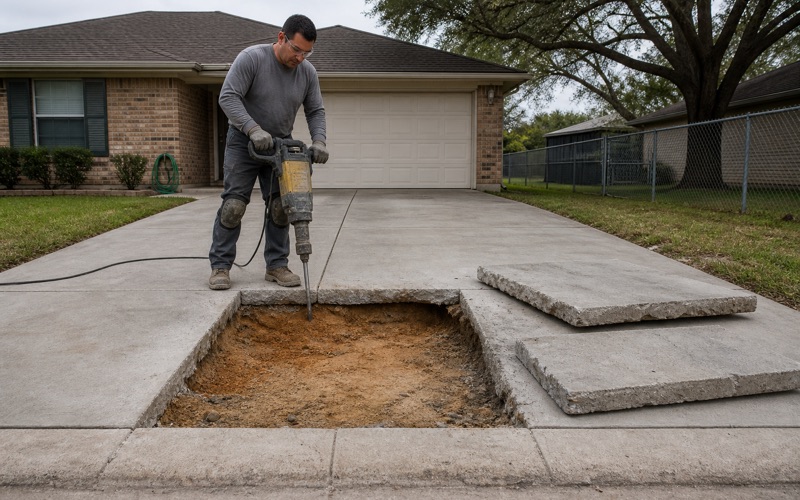
Tear-out is the contractor’s problem as well. Heavy accumulations including brick and broken concrete are excluded from city collection and must be disposed of at the expense of the owner or the firm controlling the material. We price demolition and haul-off as their own line rather than leaving it implied.
Outside the City Limits, and Under the Slab
Grimes County Runs a Separate, Stricter Regime
None of the city rules above reach unincorporated frontage, where Grimes County requires a development permit for all development. In Zone A or the base level engineering flood extent the county requires an elevation certificate, civil plans and an inspection, charges 103 dollars, and sets the lowest finished floor at 2 feet over the base flood elevation, the crown of the adjacent road or the highest adjacent grade, whichever is highest.
The county also sets an elevation rule outside the floodplain, requiring the lowest finished floor in Zone X to sit 12 inches over the highest adjacent grade measured 10 feet from the slab edge, or over the crown of the adjacent street, whichever is higher. A residential structure other than a single-family home on a slab must have its top of slab 6 inches above adjacent grade.
The County Culvert Permit and the Power Connection
The county’s driveway and culvert permit runs 26 dollars for a Type I permit including inspection, and 52 dollars for a Type II issued after a notice of violation. The county sizes the culvert and sets the flowline before construction, the applicant stakes the drive and culvert with posts at least 3 feet high with flagging at the top, and a final inspection follows installation.
Minimum culvert length is 24 feet at a minimum 18-inch diameter unless the County Engineer approves otherwise, confirmed within 7 to 30 days of application, and driveways on the same property must be separated by at least 20 feet. The sharper edge is utility related: since a January 2026 court order, permanent electric service is not connected until the county issues a Certificate of Compliance.
Sand on Top and a Claypan Underneath
The ground here is a two-soil town split roughly in half, and the trap is the sandy side. Chazos loamy fine sand covers about 15.1 percent of the mapped area, running 7 percent clay at a plasticity index of 7 with a conductivity of 91 micrometers per second to roughly 14 inches, then jumping to 43 percent clay at a plasticity index of 35. An auger in the top foot reads as sand while the slab still sits on a claypan.
Mabank and Crockett repeat the pattern at similar extents, and the heaviest ground sits on the upland slopes rather than the bottoms: Frelsburg and Latium clay carry plasticity indexes around 48 to 50 with a linear extensibility of 17 percent through the whole profile. About 69 percent of the mapped area falls in the slowest-draining hydrologic group, so water arriving under a slab does not leave through the subgrade.
- 20+ Years Experience
- Free On-Site Quotes
- Written Scope and Specs