Bryan Elite Concrete works as a concrete contractor in Lake Bryan, pouring driveways, slabs, pads, patios and repair work for property here for more than 20 years. The concrete is the same as anywhere else in this county. What is different is that nothing about the approval process resembles what a homeowner inside the city limits would go through.
There is no building official here, no permit counter and no local inspection, because this ground is unincorporated rather than part of any municipality. That is not a gap in service. It is a different structure entirely, in which a county department, a county-adopted code and a city ordinance reaching outward across the corporate limits each cover part of it.
Most of the avoidable cost on a job here comes from assuming otherwise. A quote written against the wrong code edition, a floodplain application started two weeks too late, or a driveway culvert placed without the county’s approval all cost real money, and all of them are prevented by knowing which desk owns which question before anyone orders concrete.
Who Actually Permits Concrete Work at Lake Bryan
Brazos County Road and Bridge Is the Counter
For flatwork out here the practical authority is Brazos County Road and Bridge at 2617 Highway 21 West, with plan review by the Brazos County Engineer. Driveway, culvert and mailbox work in county right of way runs through their Right-of-Way Access Permit, and development in a mapped floodplain runs through their Floodplain Development Permit.
That single address covers most of what a concrete job here touches. On-site sewage is handled separately by the Brazos County Health District, and addressing for a new structure comes from the Brazos County 911 District. We identify which of those a job needs at quote time rather than discovering it partway through.
The Code Your Slab Is Built To Here
Brazos County adopted the 2003 International Residential Code and the 2002 National Electrical Code effective September 1, 2009, and requires proof of construction compliance in the unincorporated areas. That is the edition governing residential construction on a lot here, and it is a materially older document than the one controlling inside Bryan’s corporate limits.
The practical effect is that a contractor quoting from the current edition, or from the practice they follow inside the city, is quoting against a document that does not apply to your lot. We work from the county’s own verification letter, which states the adopted editions plainly, so what we build to and what is required are the same thing.
No Zoning, No Certificate of Occupancy, No Local Registry
The county’s verification letter is equally clear about what does not exist here: no zoning ordinances in the unincorporated areas, and no certificate of occupancy issued by the county. Setbacks, lot coverage and paving rules a homeowner might expect to constrain a driveway are simply not present at county level.
There is also no municipal contractor registration to check, because there is no municipality. Texas issues no state license for concrete contractors either, which means a property owner here has no local registry to look someone up in. That puts the weight on written scope, references and a specification you can hold a contractor to.
Looking for concrete driveway contractor closer to College Station? See Concrete Driveway Contractor Services in College Station.
Driveways, Culverts and the County Right of Way
The Right-of-Way Access Permit
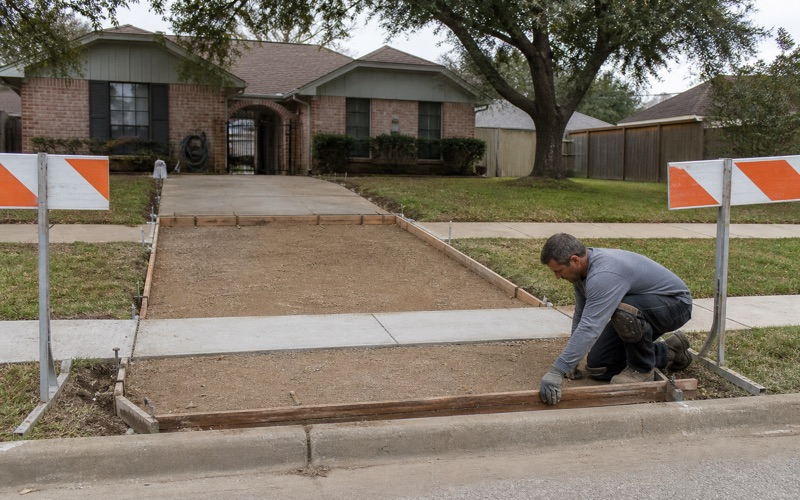
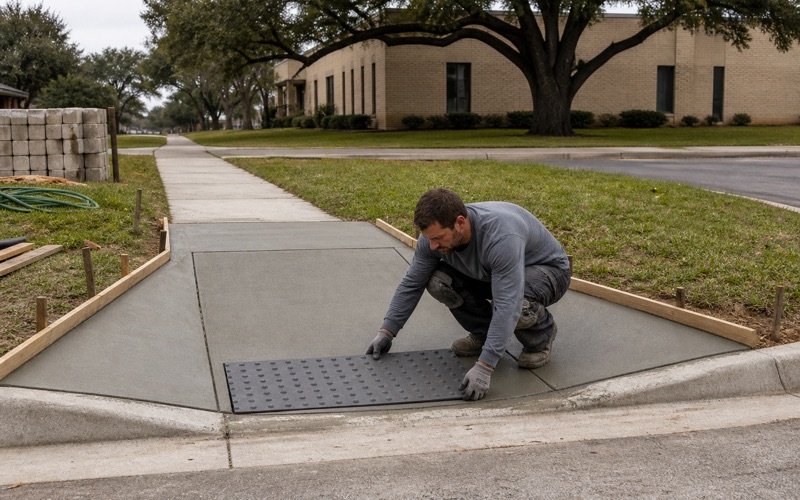
A driveway, sidewalk, mailbox or culvert in county right of way is permitted work, applied for through the county’s Right-of-Way Access Permit. The county determines the culvert required at a location rather than leaving that to the contractor or the owner, and the location is staked and inspected before anything is installed.
We handle that application, install to the size and detail issued, and compact the backfill over the pipe so the entrance does not settle into a trench line across the drive. A pipe chosen to suit the ditch rather than the drainage is one the authority can require taken back out at the owner’s expense.
Bar Ditches Instead of Sidewalks
Sidewalks are frequently not required in this jurisdiction at all. Bryan’s subdivision standards for its extraterritorial jurisdiction waive them along major streets that do not have existing curbs and gutters, and along streets in subdivisions with lots over one acre, under section 110-79(8).
That changes what the end of a driveway looks like. Instead of a curb return and a public walk, most drives here end at an open bar ditch with a culvert carrying it under the entrance, which makes the pipe, the headwall or end treatment and the compaction over them the critical details rather than the apron geometry.
Where the Extraterritorial Jurisdiction Changes the Answer
Essentially all of this place sits inside the City of Bryan’s mapped extraterritorial jurisdiction, defined in Bryan’s own code at section 110-4 as the unincorporated area contiguous to the corporate limits measured outward three and a half miles, apportioned by agreement where it overlaps another municipality and shown on an official map.
That matters lot by lot rather than in general. On a subdivision street in the extraterritorial jurisdiction with lots of an acre or more, Bryan’s subdivision code defers right-of-way and pavement widths to Brazos County standards, and a plat inside that jurisdiction needs both city and county approval. We confirm which regime an address falls in before pricing.
Two Floodplain Desks Reaching One Lot
About Twelve Percent in a Special Flood Hazard Area
Roughly 12 percent of the mapped area here sits in a FEMA Special Flood Hazard Area, split as about 11 percent Zone A, which carries no published base flood elevation, and about 1 percent Zone AE with a small mapped regulatory floodway. The remaining 88 percent is Zone X, an area of minimal flood hazard.
Zone A without a published base flood elevation is the awkward case, because the number a permit needs is not simply read off the map. That is exactly the situation where finding out early is worth money, so we check the mapped zone for the address before quoting rather than after a deposit has been taken.
The County’s Owner-Only Permit and Its Two Weeks
The county’s floodplain process has scheduling consequences a contractor cannot work around. Only property owners or their legal representatives may apply, processing runs about two weeks after all documents are submitted, and all construction must be permitted before it starts.
Failing to permit can stop construction and lead to fines or misdemeanor charges, so this is not a formality to catch up on later. Because the owner has to be the applicant, we tell you at the quote whether your job needs one and what it will need to include, and we build the two weeks into the schedule.
Bryan’s Floodplain Administrator in the ETJ
The county is not the only floodplain authority that reaches this ground. Bryan’s flood protection article applies by its own terms to the city and to its extraterritorial jurisdiction under section 46-21, appoints the city engineer as floodplain administrator under section 46-28, and calls for a floodplain development permit for proposed construction within regulatory floodplains under section 46-23.
That article adopts the Flood Insurance Study for Brazos County, Texas and Incorporated Areas dated April 2, 2014, with its accompanying rate maps. Two administrators reaching one lot is unusual and it is worth resolving in advance, because the answer decides both the paperwork and the calendar for the pour.
The Ground, and the Flatwork It Produces
Luling Clay Without a Sandy Cap
The soil most often described for this county, a sandy loam over a clay subsoil, is not the dominant condition here. Luling clay accounts for about 18.8 percent of the mapped area, across 1 to 3 percent and 5 to 8 percent slopes, and it is a well-drained upland Vertisol carrying 47.5 percent clay with a plasticity index of 38 from the surface down.
The number to design around is its linear extensibility: 7.5 percent in the top few inches and 17 percent from there to about 75 inches, with a saturated hydraulic conductivity of 0.21 micrometers per second throughout. There is no sandy cap to buy relief, so the moving layer starts under the forms rather than well below them.
Tabor, Deep Sand and Old Fill Within One Place
Tabor fine sandy loam is the other large unit at about 18.9 percent across its phases, and it is the classic regional profile: an easy 13-inch sandy and eluvial cap over a Btss horizon at 13 to 43 inches carrying 48 percent clay, a plasticity index of 39 and a linear extensibility of 10.3 percent. Excavation is straightforward to the cap and different underneath it.
Then the range widens sharply. The Robco-Tanglewood complex, about 3.8 percent of the mapped area, is hydrologic group A at 6 percent clay with a saturated hydraulic conductivity of 91 micrometers per second. Small units of clayey Ustarents and Pits record disturbed or placed material at 50 percent clay. We test what is actually on the lot rather than reading a regional average.
Concrete for Manufactured Homes
Of 670 housing units recorded here, 337 are manufactured homes, and that changes the shape of the work rather than only its scale. Pads and runners, steps and landings set to a specific height, skirting-line flatwork and carport slabs make up much of what gets poured, rather than the attached-garage apron that dominates a platted subdivision.
New rental communities are a separate matter again, because the county requires an Infrastructure Development Plan covering drainage, road and driveway plans, engineered emergency vehicle access and a survey and site plan from a Texas licensed surveyor, reviewed and approved by the County Engineer and Commissioners Court. Paving there is an approved engineering item rather than an owner’s choice.
- 20+ Years Experience
- Free On-Site Quotes
- Written Scope and Specs