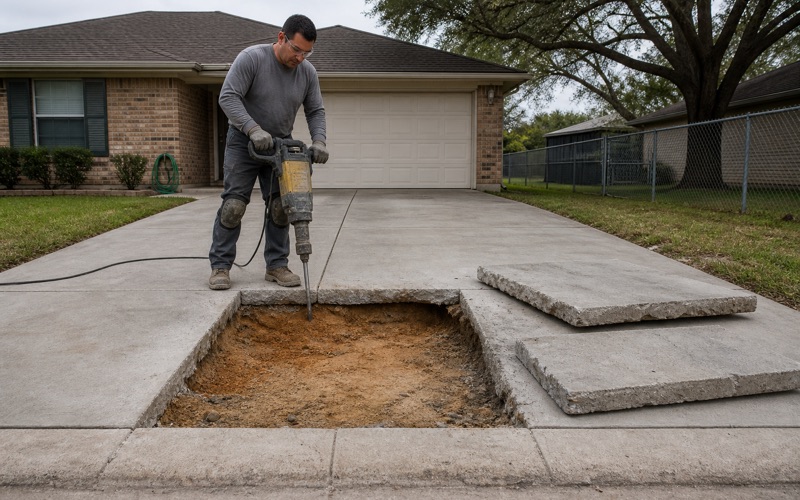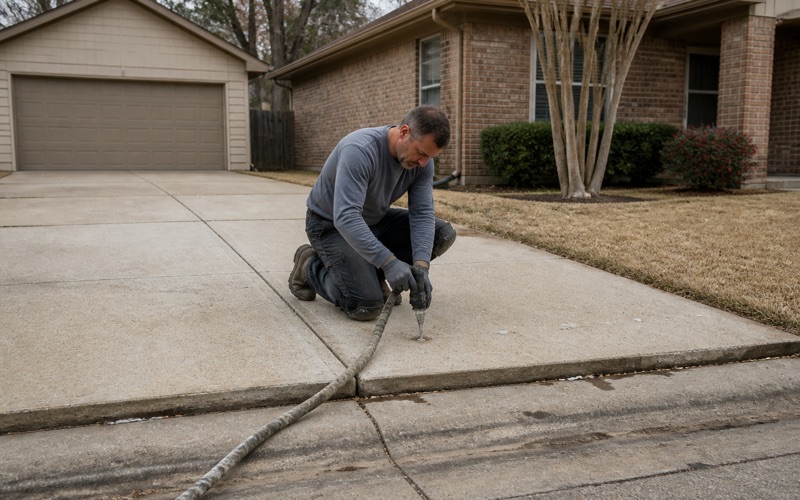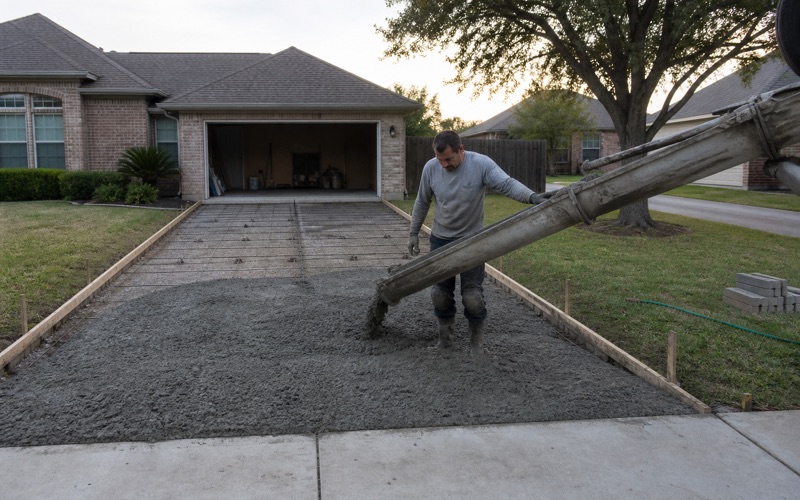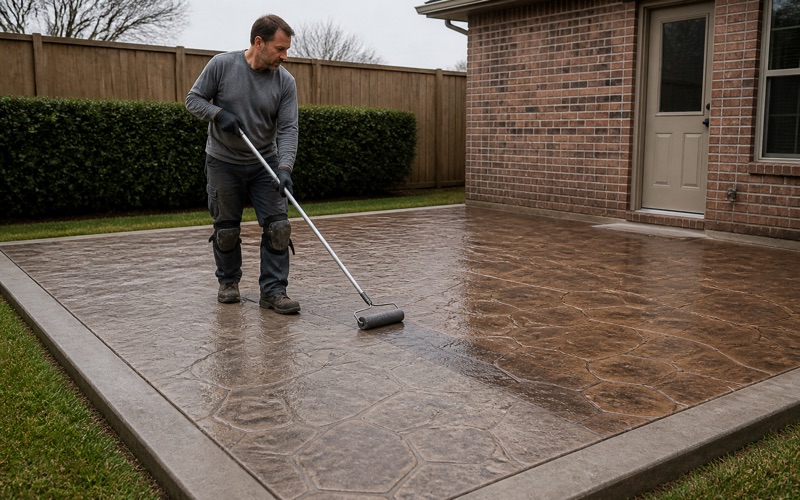
Bryan Elite Concrete works as a concrete contractor in Gause, pouring shop slabs, barndominium pads, equipment pads, driveways and rural flatwork with more than 20 years behind the crew. The regulatory picture here is unusual in a way that cuts both directions, and it is worth understanding before anyone quotes a job.
Nobody inspects your slab here. There is no city hall, no building official and no building permit of any kind for a one- or two-family dwelling, so the foundation under your shop or your house is between you and whoever pours it. Nobody checks the steel, the base or the mix.
What is regulated, and regulated closely, is the road. Touching a county road with a new entrance means a permit, a site meeting, a culvert the county specifies and real penalties for skipping the process. So the one place a rural concrete job here meets an authority is where the driveway leaves your property.
Who Actually Permits Concrete Work Here
No Building Authority for a House or Shop
Milam County does not run a building department for one- and two-family dwellings, and the commentary to its own fire code says so plainly: the Fire Marshal’s Office does not issue permits for one- and two-family dwellings. There is no local building official reaching this ground and no inspection of a residential slab.
That puts everything on the written scope. With no inspector in the sequence, the specification, the compaction record and the batch tickets are the only evidence the job was built properly, so we produce all three as standard here rather than only where someone asks for them.
Commercial Work Runs Through the Fire Marshal
Commercial concrete is different. The Milam County Fire Code, effective May 26, 2025, applies to commercial establishments, public buildings and multi-family residential dwellings of four or more units built in the unincorporated area, and it reaches paving geometry directly.
Fire apparatus access roads must be at least 24 feet of unobstructed width exclusive of shoulders, with 14 feet of vertical clearance, designed and maintained to support imposed loads of 85,000 pounds and surfaced for all-weather driving. Dead ends over 150 feet need a 120-foot hammerhead, a 60-foot Y or a 96-foot diameter turnaround, and dead ends from 501 to 750 feet must be 26 feet wide.
Fire Lane Marking and the Site Plan Permit
Marking is prescriptive rather than a matter of taste: continuous six-inch red lines at the lane boundaries, the words NO PARKING FIRE LANE in four-inch white letters at 25-foot intervals on both sides, striping on the vertical face where a curb exists, and signs 12 by 18 inches with the bottom six feet six inches above finished grade at no more than 50-foot spacing.
A construction permit is required to install or modify a fire apparatus access road, except where site or civil plans covering it are submitted with a building permit. The county’s fire fee schedule prices a site and civil plan review and permit at $500.00, which allows a contractor to clear, grade, set forms, pour a foundation and install fire access and hydrants ahead of a building permit.
Looking for concrete contractor closer to Navasota? See Navasota Concrete Contractor.
The County Road Entrance Permit, Step by Step
Fees, Filing and What Triggers One
A permit from the county is required for any driveway connecting to a county road, filed through Planning and Development at 102 South Fannin in Cameron. The private and agricultural fee is $25, a noncommercial joint access driveway $50, a business driveway $150 and an industrial driveway $5,000, each plus additional fees for any structure placed in the right of way.
Reworking an existing entrance can pull a new permit too. Item 18 of the county rules, adopted July 27, 2023, provides that an existing entrance being significantly redesigned or reworked may require a new application, with both the significance of the work and the need for a new application left to the precinct commissioner’s discretion.
The Site Meeting and the Seven-Day Answer
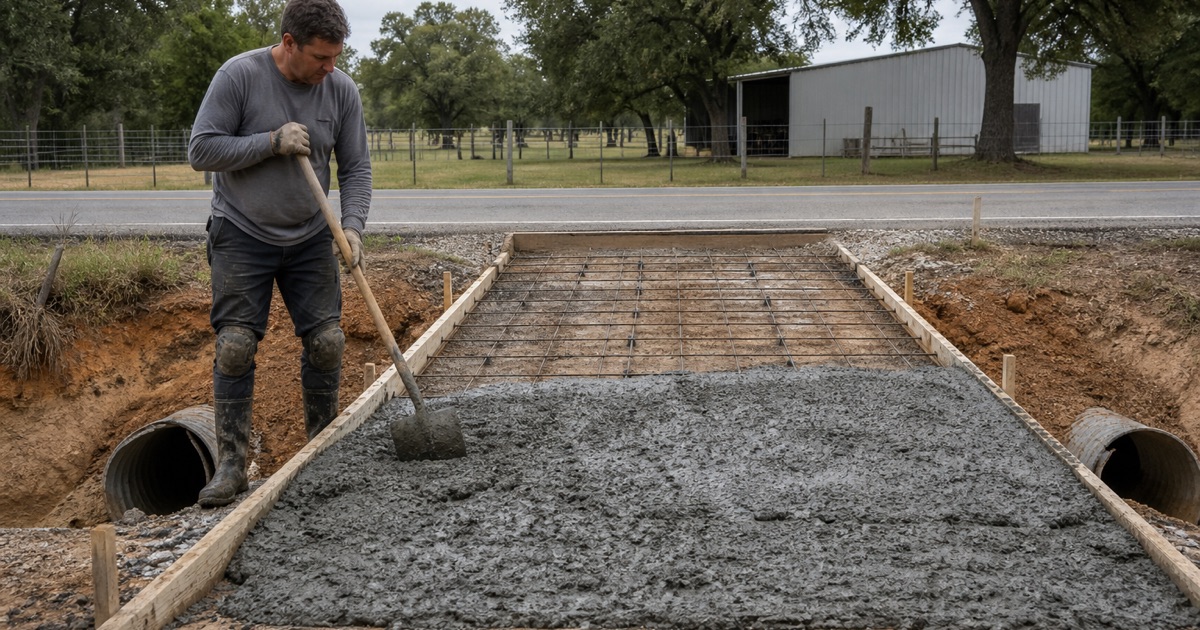
The commissioner for the precinct meets the applicant on site and determines the required culvert diameter, length and type, including concrete abutments where necessary, then notifies the applicant of the specification within seven days. That is a real step in the calendar rather than a formality, and it comes before any concrete is ordered.
The county installs noncommercial culverts itself at $15.00 per foot, providing labor, equipment and enough flexible base to cover the pipe to the edge of the county-maintained easement. Minimum culvert length is 30 feet, and the pipe is corrugated galvanized metal unless the commissioner permits an alternate material.
Where the County Stops and You Start
The split of responsibility is worth being explicit about, because it decides what belongs in our quote. The county covers the culvert to the edge of its maintained easement; the entrance surface, fencing, gates and road surface materials are the applicant’s sole obligation.
Skipping the permit is expensive. Installing a driveway without one carries a penalty of $500 for a private or agricultural entrance, $1,000 for a business entrance and $20,000 for an industrial entrance, appealable to the Commissioners Court. Existing driveways and their maintenance stay with the current landowner.
Address Rules That Gate the Permit
Two requirements catch people out. The drive has to be located within 25 feet of the designated 911 address, and no driveway permit issues at all until the applicant has obtained that address, with agricultural entrances excluded from the address requirement.
Each entrance serving a residential or commercial building must then carry a reflective address marker in numbers no less than two inches high, visible from the county road, which may sit on an adjacent mailbox. No more than two properties may share a joint driveway without a private road designation, and gated entrances used for trailered traffic need the gate at least 60 feet back from the maintained easement.
Highway Frontage and Flood Rules Without a Map
When TxDOT Takes Over
Frontage on US 79 or US 190 moves the permitting somewhere else entirely. A driveway connecting to the state highway runs on TxDOT Form 1058, the permit to construct access driveway facilities on highway right of way, filed with the Bryan District rather than with the county.
The sequence there is strict: no construction may be undertaken on the right of way until a fully executed permit has been received and the applicant has given 24-hour notification, and a state inspector reviews the work before the drive counts as an authorized installation. We file it and build the notice into the schedule.
A Floodplain Permit With No Flood Map
Unincorporated Milam County has no effective flood insurance rate map. The community record shows it in the National Flood Insurance Program Emergency Program since February 29, 2000, with no initial hazard boundary map, no initial rate map and no effective map date, and the national flood hazard layer holds no panels for it. There is nothing to look a lot up on.
A floodplain development permit is nonetheless required for all development in the unincorporated area, not only in a mapped hazard area, with the County Judge or the Judge’s designee as floodplain administrator. Violation is a misdemeanor, each day is a separate offense, and the fine runs to $500 for each violation plus the costs of the case.
The Three-Times-Width Elevation Rule
Because there is no map, the county’s flood damage prevention order supplies a default: where areas of special flood hazard have not been identified and water surface elevations have not been provided, all development within three times the bank-to-bank width of a stream, measured from the nearest bank, must be elevated at least three feet above natural ground.
That is a slab elevation rule triggered by a tape measure rather than by a map panel, and it reaches a house pad or a shop slab near any creek out here. We measure it at the site visit, because it changes fill volume, forming and cost far more than most people expect.
Sand Over Clay, and How Deep the Clay Starts
Roughly Four Fifths of the Ground Is Sandy on Top
This is sand-over-clay country rather than heavy ground. Every named soil component mapped inside the community is an Alfisol, and around 80 percent of the mapped area sits in units whose surface horizon is loamy fine sand or fine sand. Rader loamy fine sand alone accounts for about 47.8 percent, with Travis at 16.9 percent and the Lufkin-Gause complex at 11.8 percent.
The soil series named for this place is mapped here: a loamy fine sand surface 14 to 16 inches deep at 10 to 15 percent clay and a plasticity index of 3 to 6, over an argillic horizon of 42.5 percent clay at a plasticity index of 23. Conductivity drops from as much as 92 micrometers per second in the sand to about 1 in the clay beneath it.
The Reactive Unit Is Shallow, Not Deep
The one high-movement soil here is Lufkin, and its clay begins about six inches below the surface, running to about 54 inches at 42.5 percent clay, a plasticity index of 38, a linear extensibility of 17 percent and a conductivity of 0.21 micrometers per second. On that unit the reactive layer sits directly beneath a slab rather than several feet down.
Everything else sits deeper. Clay depth runs about 17 to 18 inches on Rader and Travis, 14 to 16 on the local series and 29 to 66 on the deep sands. That range is why we open the ground before pricing rather than assuming the lot next door describes yours.
Deep Sand, Gravel and What Each Demands
Padina and Silstid are the deep-sand units, carrying as little as 6 to 7 percent clay with plasticity indexes of 1.5 to 3 and conductivity around 92 micrometers per second. These are low-cohesion subgrades where the problems are form stability, edge slump and washout under an unformed edge rather than heave, so the answers are different too.
Jedd very gravelly sandy loam, mapped on 3 to 15 percent slopes, is the only unit here with a root-restrictive layer, at weakly coherent paralithic bedrock about 25 inches down. Excavation there reaches rock rather than clay, and on those slopes grading and form work drive the job more than soil movement does.
- 20+ Years Experience
- Free On-Site Quotes
- Written Scope and Specs