Bryan Elite Concrete works as a concrete contractor in Cameron, pouring driveways, approaches, slabs, pads and repair work with more than 20 years behind the crew. The first question on any job here is not what it costs. It is which counter it belongs to, and the answer turns on what your driveway meets at the end of it.
A drive meeting a city street is a city matter, handled through the right of way ordinance rather than through any flatwork permit, because this city has no flatwork permit at all. A drive meeting a county road is a county matter, handled through the County Road Entrance permit and, before that, the Development Permit.
Both counters sit within a block of the courthouse square, which makes the practical difference easy to miss and expensive to get wrong. We establish it at the site visit, because the permit, the timeline, the culvert decision and the inspection all follow from it.
Which Counter Your Job Belongs To
The County Office at 102 South Fannin
The county’s Planning and Development Office at 102 South Fannin takes both the Development Permit and the returned County Road Entrance permit. That is the desk for anything on county frontage, and it is where the culvert question gets settled before any concrete is ordered.
Because both offices are close together, owners often assume one approval covers the other. It does not. A city right of way permit says nothing about a county road entrance, and a county entrance permit does not authorize work in a city street.
The City Has No Flatwork Permit
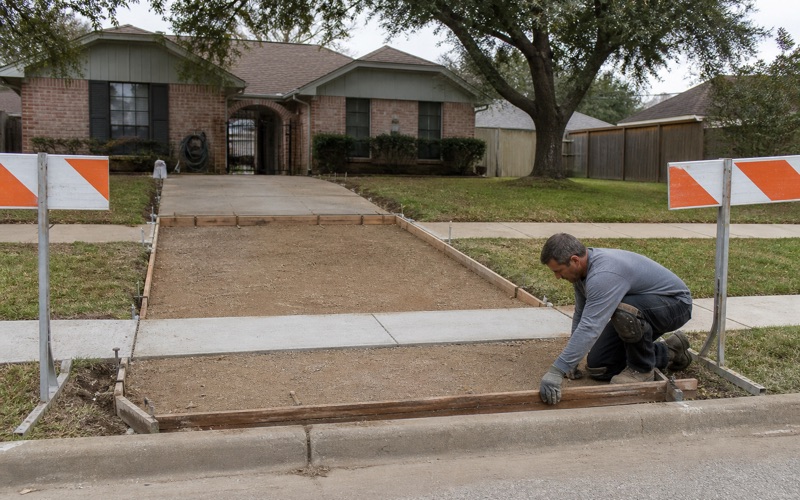
There is no driveway permit, patio permit or slab permit in this city’s code. What exists instead is a right of way regime, and that is where driveway approaches and public sidewalks land, so the question is not whether flatwork is permitted but whether the work touches the street.
That absence cuts both ways. A patio in a back yard here answers to very little, while an approach at the curb answers to a permit, a bond and an inspection. We tell you which of those you are buying rather than quoting one price and discovering the other.
An Old Code Edition Governing Foundations
The building codes adopted here are the 2000 editions, adopted by an ordinance in December 2001, and the codified fee schedule still heads its building permit table with that edition. A quarter-century-old edition governs footings, anchorage and slab provisions in this city.
That matters because a contractor quoting from a current edition, or from practice picked up in a city that adopted one, is quoting against a document that is not in force here. We work from what this city has actually adopted rather than from what most places have.
Looking for concrete contractor closer to Lake Bryan? See Concrete Contractor in Lake Bryan.
Off a City Street: the Right of Way Permit
What Triggers It
Section 3.14.072 requires a permit for excavation of right of way or street, for construction activity in right of way or street, defined as adding, repairing, removing or altering any facility in, over, under, through, along or across a street or right of way, for permanent structures occupying right of way, and for temporary obstruction of it. Each requires a design plan submitted for review before the work.
That definition is broad enough to catch most approach work and any public sidewalk repair, and the design plan requirement means the detail is settled on paper first. We prepare that plan rather than treating it as a formality to be sketched at the counter.
Priced, Bonded and Inspected
The fee structure sets a construction permit minimum of $250.00 for activities other than excavation and an excavation permit minimum of $250.00, each with an inspection fee of $50.00 per month, plus a $2,000.00 bond for construction activity, excavation and cutting work. Street cut repair is priced at $15.00 per square foot.
The bond is the part worth planning for on a small job, because it does not scale down with the work. We carry those costs in the proposal as their own lines so the price of the concrete and the price of working in the street are visible separately.
The Mix and Mesh the City Names
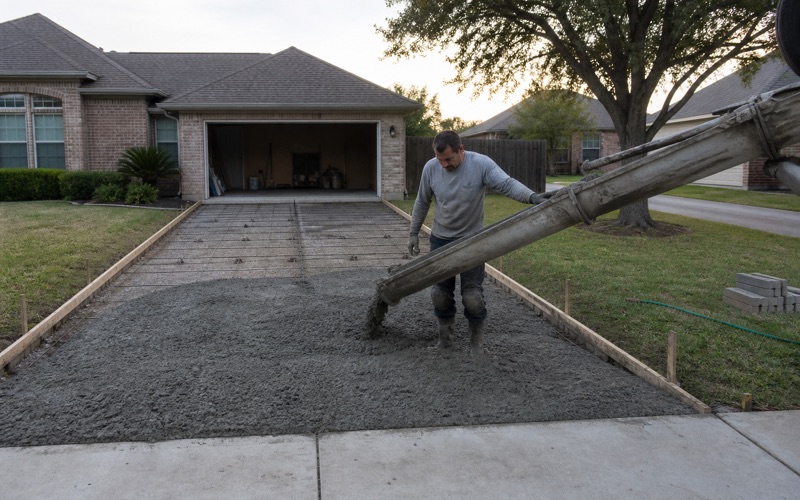
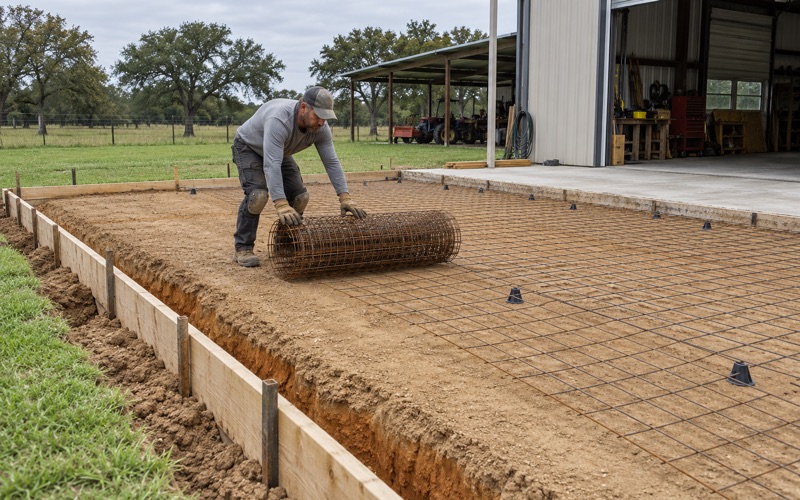
Section 3.14.115 specifies the slab by name rather than by performance. It calls for reinforcement with six-inch by six-inch number 6 wire mesh supported throughout placement so it sits approximately equidistant from the top and bottom surfaces, and for High Early type III portland cement producing 2,500 psi concrete at three days, or as directed by the city, cured and closed to traffic per state specifications.
Section 3.14.114 sets what goes underneath: trench width held to a minimum, fill installed in six-inch layers each compacted to 95 percent density, a six-inch slab over the trench extending 12 inches past it on each side, and the top of the slab 2 inches below the surrounding paving. We build to that rather than to a generic detail.
A One-Year Warranty That Excuses Joint Cracks
Section 3.14.034(c)(1) binds a permittee to keep the work in good, sound, smooth and serviceable condition free from cracks and defects for not less than one year from completion, then carves out an exception worth knowing about: cracks appearing in expansion joints or cuts between blocks are not deemed defects unless the building official considers them excessive in opening or in surface deflection.
That is the code agreeing with what concrete actually does, and it is why joint layout matters so much on this kind of work. Section 3.14.119 runs a parallel one-year liability for damage from settlement due to pavement cuts, so backfill and compaction carry the same twelve-month tail.
Off a County Road: Entrance Permit and Culvert
The Entrance Permit and Its Fees
A driveway connecting to a county road needs a permit, priced by use: 25 dollars private or agricultural, 50 for a joint access driveway, 150 for a business driveway and 5,000 for an industrial one. Skipping it carries a 500 dollar penalty on a private or agricultural entrance, and heavier penalties on the commercial tiers.
The county also runs a road use bond of 250,000 dollars for gravel pit and energy traffic, which is a reminder that these roads are built for a heavier axle mix than a residential street. We size an approach on a haul route accordingly rather than treating it as an ordinary drive.
Who Buys the Pipe, and Who Sets It
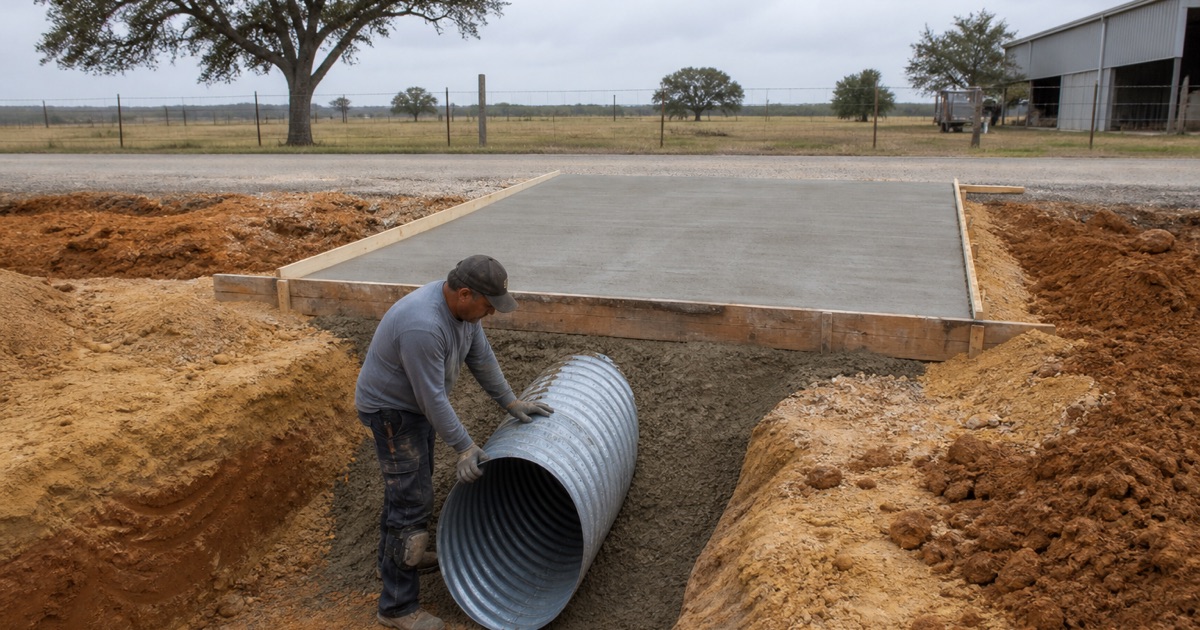
On a noncommercial entrance the county installs the culvert itself at 15 dollars per foot with a 30-foot minimum, providing the labor and the equipment. The pipe is corrugated galvanized metal that the customer buys and has delivered to the site, which surprises most owners the first time.
The county representative determines the diameter, the length and the type after seeing the location, so nobody guesses it. We coordinate the delivery and the timing so the pipe is on site when it is needed rather than holding up an entrance for a week.
The Development Permit Comes First
Outside the cities, a Development Permit is required before work of any kind starts, and the checklist reaches flatwork drainage directly by naming drainage improvements including culvert work among its other development activities. It is not a building permit and it is not optional.
We file it before dirt moves rather than after, because the county treats starting without one as a genuine enforcement matter rather than a paperwork lapse. On a rural job that sequence is what keeps the concrete date from slipping.
What the Ground Does, and Where the Rubble Goes
A Sandy Surface Over a Much Stiffer Subsoil
Minwells fine sandy loam covers 62.5 percent of the mapped city area, and its profile is the local story in one column: about nine inches of 63 percent sand at 13 percent clay and a plasticity index of 8, sitting directly on a horizon at 42 percent clay with a plasticity index of 30. Conductivity falls from 28 micrometers per second to 1.0 across that boundary, a twenty-eight-fold drop.
The Wilson-Davilla complex adds a further 9.2 percent with the same shape and a shorter sand layer, Wilson carrying a plasticity index of 16 at the surface and 32 below at 42.5 percent clay with a very high runoff class. A subgrade test from the top foot describes the sand and not what the slab bears on.
Sidewalks, Ramps and the Square
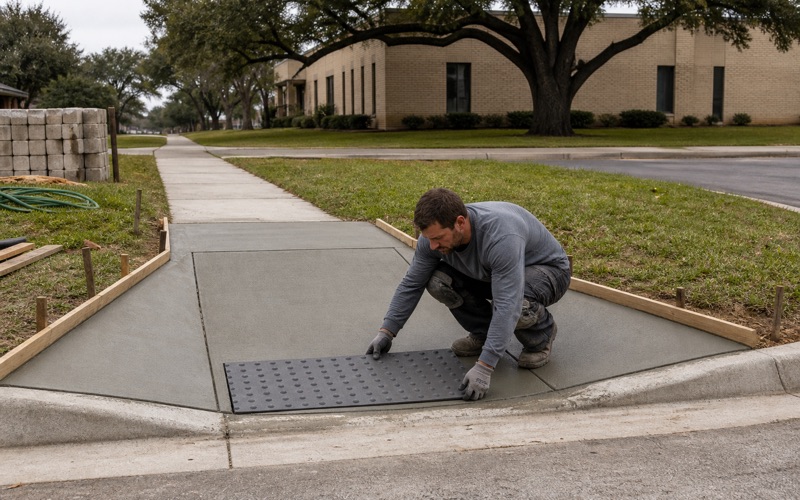
Public walk work here runs through the same right of way regime as an approach, so the permit, the bond and the inspection apply to it as well. Accessibility work has its own threshold to watch: state licensing rules bring registration and review into play once a project’s construction cost reaches 50,000 dollars.
Around the square that combination matters, because a walk replacement, a ramp and a curb detail can add up faster than an owner expects. We scope those together and price the review path with them rather than treating accessibility as an afterthought at the end.
Your Tear-Out Is Not Going to the City Site
The city’s disposal site is closed to the trade. The fee schedule’s dump heading opens by stating that no commercial or industrial users or collection vehicles are allowed, then prices household quantities by the bag, the drum and the trailer load.
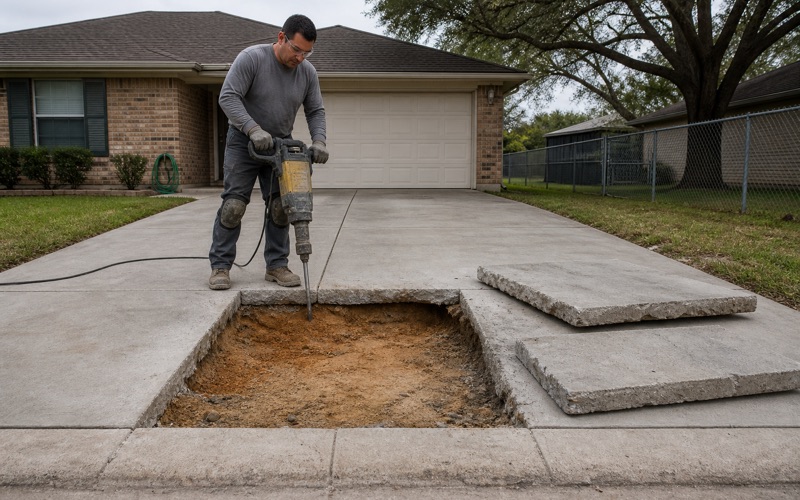
So a driveway tear-out here leaves town on a truck to somewhere else, and that haul is a real line rather than a rounding error. We price demolition and disposal explicitly, and on right of way work we meet the erosion control the code requires around any excavation left open overnight, along with the barricading it calls for.
- 20+ Years Experience
- Free On-Site Quotes
- Written Scope and Specs