Bryan Elite Concrete works as a concrete contractor in Brenham, pouring driveways, slabs, patios, aprons and commercial flatwork with more than 20 years behind the crew. This city is genuinely two different jobs depending on the address, and a contractor who quotes it as one is going to be wrong about half the time.
The most extensive mapped soil inside these city limits is a sand. Klump loamy sand covers about 30.19 percent of the mapped area, carrying 6.5 percent clay and a plasticity index of 2 at the surface and never exceeding a plasticity index of 11 anywhere in its profile. The second most extensive is Frelsburg clay at about 20.57 percent, at a plasticity index of 36 to 39.
Those are not neighboring towns. They are neighborhoods in the same city, and the city’s own paving standard fires a stabilization requirement on one of them and never on the other. Which side you are on is the first thing we establish, because it changes the specification and the price.
The Sand Side and the Clay Side
What Is Actually Mapped Here
Map units with a sand or sandy loam surface total roughly 43 percent of the mapped soil area inside the city, clay surfaces about 35 percent and clay loam or sandy clay loam surfaces about 22 percent. Klump leads at about 30 percent and drains rather than perches, with a surface conductivity of 28 micrometers per second.
On the heavy side, Frelsburg carries 50 to 56 percent clay at a plasticity index of 36 to 39 to about 91 inches, Bleiblerville adds roughly 8 percent of the area at a plasticity index of 44 to 47, and Latium adds about 6 percent at a plasticity index of 48 with a linear extensibility of 17 percent from the surface down to 80 inches.
The Soils That Mislead a Clay Number
Two local soils punish reading clay percentage alone. The series named for this city is a carbonatic Calciustoll running 30 to 47.5 percent clay at a plasticity index of 22 to 32, yet its linear extensibility is only 4.5 percent through the whole profile, because the fines are calcium carbonate rather than reactive clay.
Chazos loamy fine sand, about 5 percent of the mapped area, misleads in the other direction: 7 percent clay and 84 percent sand with a conductivity of 91 micrometers per second in the top 14 inches, sitting directly on a horizon of 43 percent clay at a plasticity index of 35. A shallow test pit reads sand while the slab bears on a claypan.
Rock, Bottomland and the Odd Corner
Carbengle clay loam, roughly 7 percent of the mapped area, is the one common local soil with rock inside footing reach, at weakly coherent paralithic bedrock 29 to 34 inches down. A minor Renish unit carries indurated bedrock at 12 to 15 inches, and Crockett carries densic bedrock at 51 to 59 inches.
About 7.4 percent of the city is in frequently flooded units. Bosque clay loam is the mild one at 31 percent clay with a linear extensibility of only 1.5 percent, while Trinity clay is the most plastic soil mapped anywhere in the city at 65 to 70 percent clay and a plasticity index of 47 to 52, with flooding mapped from February through May.
Looking for concrete contractor closer to Rockdale? See Rockdale Concrete Contractor.
What Lime Stabilization Costs When It Fires
The Trigger, and Where It Applies
Section 6.11.F of the city’s Public Infrastructure Design Manual requires subgrade to be stabilized a minimum of 6 inches thick to bring the plasticity index down to 15, determined by a lime series, with lime applied to the state highway specification. Washington County’s own manual uses the same trigger for county roads.
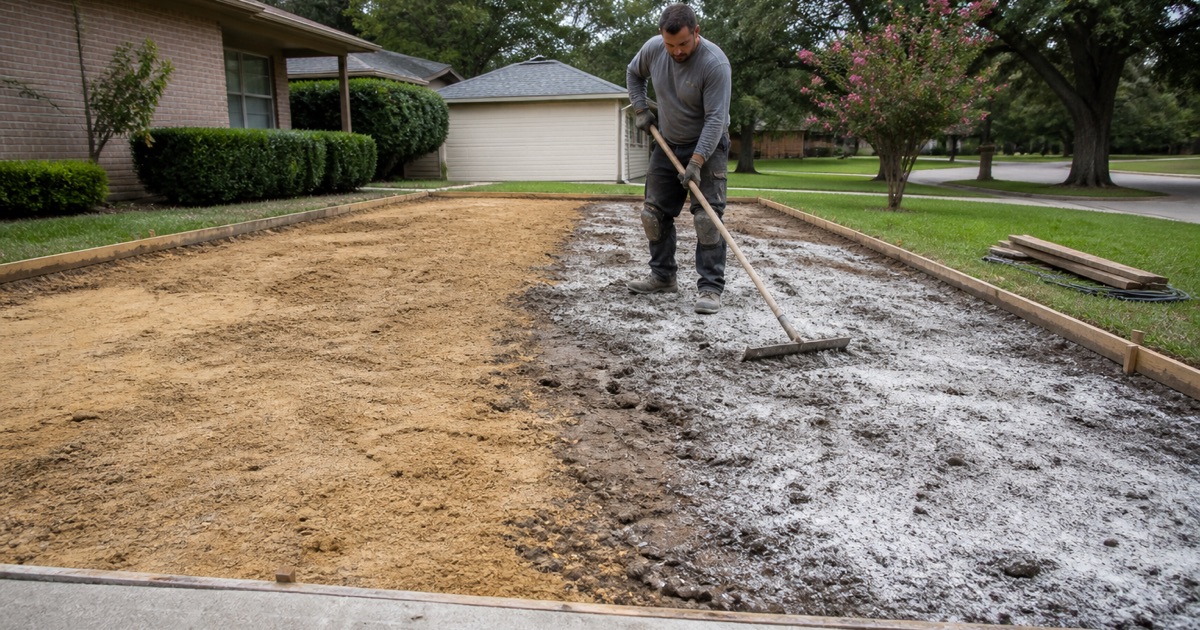
That single number splits the city. On Klump the trigger is never reached and no stabilization fires at all. On Frelsburg, Bleiblerville and Latium it always fires, and the cost, the schedule and the equipment on site all change accordingly.
What Happens When Lime Is Not Enough
The manual anticipates soil that will not come down. Where a plasticity index of 15 or less cannot be obtained, the lime-treated soil must instead reach a pH of 12.4, the treated depth increases from 6 to 8 inches, and compaction is held at 95 percent standard Proctor.
That escalation is worth pricing honestly at the quote rather than discovering after the lime series comes back. On the heavy side of town we test first and quote the stabilization as its own line, because the difference between a stabilized and an unstabilized subgrade is not a rounding error on a driveway.
Mix and Aggregate Are Both Named
The public works standard here specifies 3,500 psi at 28 days with a minimum of five and a half sacks of cement per cubic yard, Grade 60 reinforcing steel to ASTM A615, slump between two and a half and 5 inches, entrained air not exceeding 5 percent and concrete temperature not over 95 degrees without appropriate admixtures. The county sets the same 28-day strength.
The aggregate is named too. Section 6.12 provides that limestone shall be used wherever possible, that granite is permitted only with prior city approval, and that river rock and similar hard aggregates are not permitted. We order to that rather than to whatever the plant would otherwise send.
Permits, Surveys and the Pre-Pour Sequence
Flatwork Needs a Permit Here
A driveway, a commercial parking lot and a sidewalk each require a building permit in this city. The published list of work requiring permits names foundations, driveways, commercial parking, sidewalks, retaining walls, carports, decks and swimming pools, while the exempt list runs to painting, wallpapering, carpeting, flooring, cabinets and countertops.
Residential flatwork is charged as paving by area, at $50.00 for up to 500 square feet and $100.00 for 501 square feet or more, on top of a $25.00 base fee applying to all permits, with residential foundation repair at $75.00 and commercial paving charged on valuation. Work done before a permit is acquired may be charged double the total permitting fee.
The Form Survey Lands Before the Truck
The pre-pour sequence here is specific and it covers flatwork rather than only the house. The residential inspection guide lists inspection four as Slab and Flatwork, naming driveways and sidewalks, and requires a foundation form survey from a licensed surveyor before the slab inspection is requested.
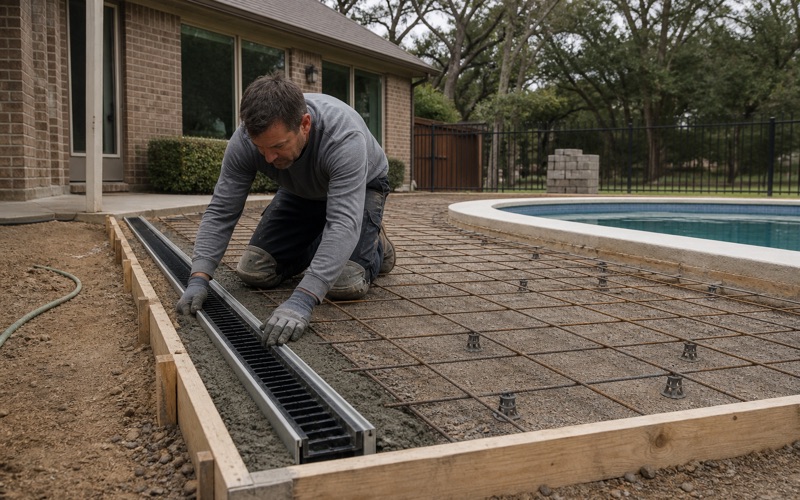
That requirement sits in the ordinance as well: section 6-27 amends the building code to require form surveys performed by a Texas registered professional licensed surveyor to be submitted before approval of the foundation inspection, with an exception available from the Building Official on properties over an acre. Slab inspections happen after in-slab steel, conduit and piping are in place and before any concrete is placed.
Small Local Amendments With Real Teeth
Two smaller amendments reach the slab directly. The contractor must set a string line on a minimum of two property lines, the front and one side, in place at the time of the foundation inspection, with the inspector free to ask for more.
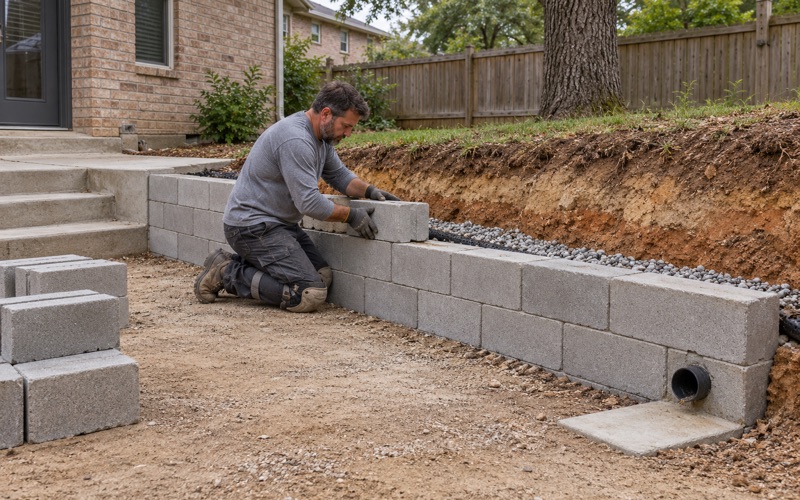
Section 6-76.1 adds a plumbing requirement that vertical drain and vent piping penetrating a concrete foundation be wrapped with foam or another approved material to seal the space around the pipe and prevent contact with cement, expressly disallowing black tar or mastic for that purpose. Retaining wall construction, and any cut or fill on improved property, both need written city approval beforehand.
Driveways, Downtown and the County Line
The Thickness Table and the Right-of-Way Bond
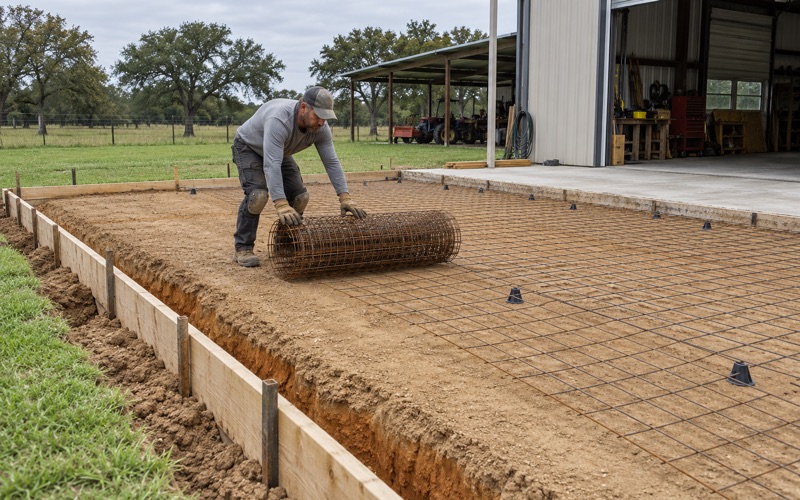
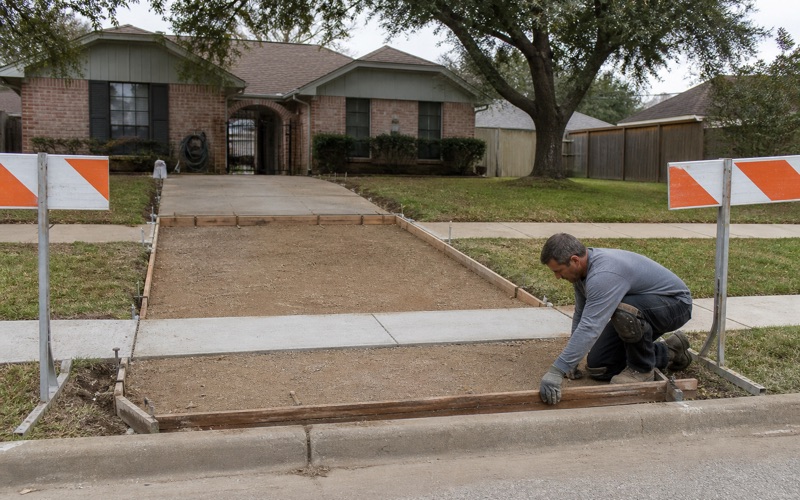
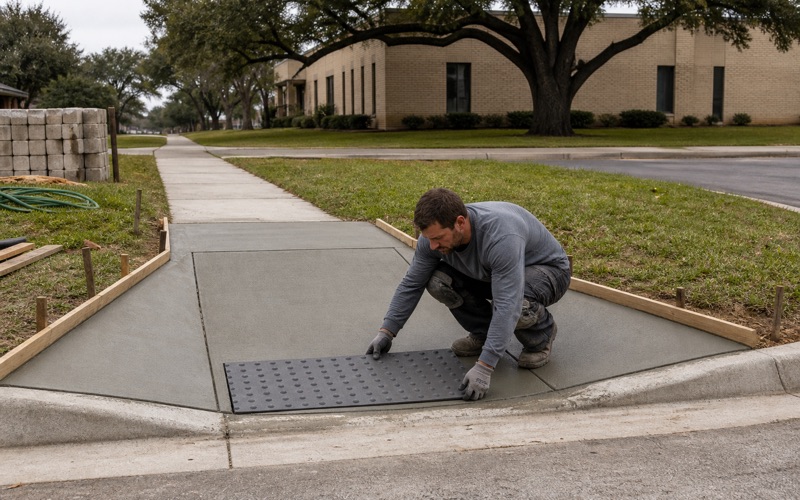
Driveway construction here is a table rather than a paragraph. Minimum concrete thickness in the right of way is 5 inches residential with number 3 bars at 12-inch centers, 6 inches commercial with number 4 bars at 12-inch centers and 8 inches industrial with number 5 bars at 12-inch centers, with slope to the accessibility standards.
Right-of-way work carries a bond as well: a residential driveway requires a $2,000.00 bond or 120 percent of the cost of the work, with a one-year maintenance obligation attached. We quote right-of-way work knowing that obligation comes with it, which is another reason the base under it gets built properly the first time.
Downtown Matching, and Who Owns the Public Walk
Downtown carries a matching rule that is often described wrongly. It is a coloration and texture matching requirement filed on the masonry side rather than a specified surface finish, so the obligation is to match what is already there rather than to apply one prescribed texture.
The public sidewalk here also works the opposite way to most cities nearby. Section 22-37 has the city making required repairs at city expense, except along six named thoroughfares, so an owner is not carrying that duty by default. We check which frontage a property sits on before quoting walk repair.
Bottomland, Culverts and Washington County
Outside the city, Washington County sets its own culvert rules: an 18-inch minimum diameter, lengths of 24 to 40 feet for a residential drive, and corrugated metal or reinforced concrete pipe only. Its design manual matches the city on concrete strength and on the stabilization trigger, so the specification does not shift at the line even though the permit does.
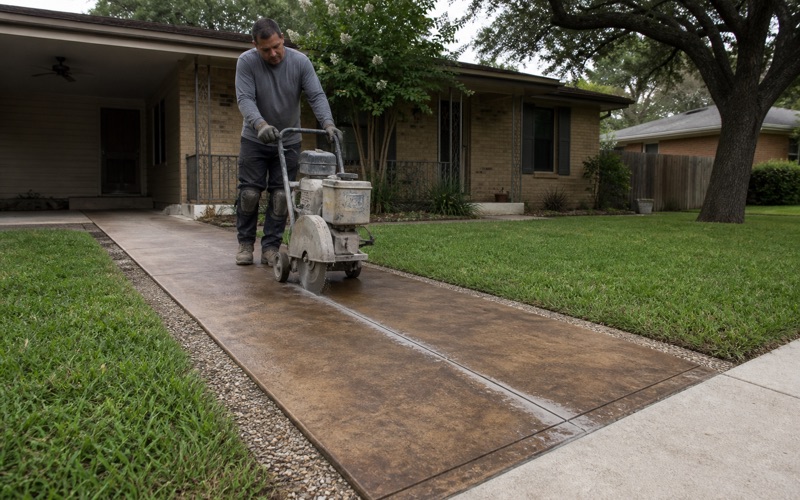
Inside the city the zoning ordinance sets a six-inch dumpster pad, and the design manual’s finish rules are worth reading together rather than separately, since one section calls for a light broom finish while the pavement testing section specifies a burlap-drag or tight belt finish and allows removal of pavement that is excessively smooth or rough. We build to the stricter reading and cure with a membrane compound as the manual requires.
- 20+ Years Experience
- Free On-Site Quotes
- Written Scope and Specs